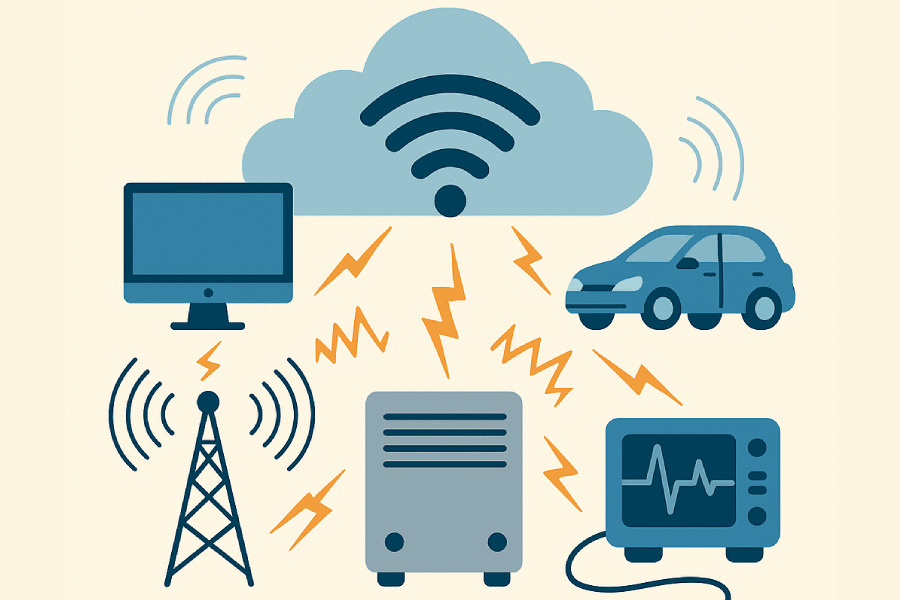
Electromagnetic compatibility, EMC for short, is the ability of an electronic device or system to work correctly in its electromagnetic environment without adding to that environment interference that other equipment could not tolerate. The interference has a name of its own: electromagnetic interference, or EMI.
Put simply, a compatible device neither disturbs its neighbours nor is disturbed by them. That requirement now runs through the specifications of most industrial electronics, and well beyond.
EMC: a definition in two halves
Every electrical or electronic device produces some level of electromagnetic interference, and that interference can affect equipment nearby. EMC therefore has two sides:
- Emission: what the device sends out, through the air or along its cables. It has to be limited.
- Immunity: how well the device withstands the disturbances present where it is used. It has to be sufficient. Susceptibility is the same idea seen from the other side.
A device is compatible when both conditions are met at once.
Why EMC matters
Interference between devices
Not long ago, airline passengers were asked to switch off their mobile phones for take-off and landing, and some hospital areas are still closed to them: a phone can generate interference that disturbs vulnerable equipment. FM radio is the everyday case. It is broadcast between 87.5 and 108 MHz in most countries, and a badly suppressed vacuum cleaner, drill or LED driver nearby can produce noise in the same band, so the programme crackles or drops out.
The consequences range from a nuisance to a real hazard, and several sources can add up: the emissions of several laptop computers, combined with those of mobile phones, could disrupt systems in an aircraft.
Regulation and market access
Standards set emission limits, immunity test levels and the measurement methods that go with them. Among those that come up most often: the IEC 61000 series, CISPR 32 for multimedia equipment, RTCA DO-160 for airborne equipment and MIL-STD-461 for military equipment.
- In the European Union, the EMC Directive 2014/30/EU requires that equipment neither disturbs other equipment nor is disturbed by it; the CE marking is affixed once conformity has been assessed.
- In the United States, Part 15 of the FCC rules sets the conditions under which a device that radiates radio-frequency energy, intentionally or not, may be operated without an individual licence and placed on the market.
Where electromagnetic interference comes from
Inside the equipment
- Power electronics that switch high voltages at high frequency: converters, inverters, chargers.
- Switch-mode power supplies.
- Electric motors.
- Power and signal lines, which carry the noise out of the unit.
The disturbance travels in two ways: radiated, through the air, or conducted, along power and data cables.
Outside the equipment
- Radio transmitters and mobile phones.
- Industrial surroundings: variable-frequency drives and other power electronics.
- Power lines and large batteries.
- Electrostatic discharge.
A device that is well designed goes on working in all of these conditions.
A more crowded electromagnetic environment
There are more electronic devices every year, and they are smaller and faster than their predecessors. Wireless links such as Wi-Fi, Bluetooth and 5G add transmitters everywhere. The IEC notes that the need for EMC standards keeps growing with new technologies, miniaturisation and electronics that operate over a wide range of frequencies.
The response is a matter of design: lower emissions at the source, adequate immunity and, around the electronics, electromagnetic shielding.
How electromagnetic compatibility is achieved
The techniques fall into two families. Avoidance removes the source of the disturbance or reduces its emissions. Mitigation, by filtering or shielding, limits the effect of what remains.
Design and shielding
EMC is dealt with from the design stage. A shield is a conductive barrier placed around the part that is sensitive, or around the part that is noisy. It takes several forms:
- Conductive metal enclosures.
- Foam gaskets wrapped in conductive fabric (fabric-over-foam).
- Knitted wire mesh.
- Spring finger strips in beryllium copper.
- Conductive coatings on plastic housings.
A metal enclosure leaks mostly at its openings: doors, removable panels, the joints between covers, connector cut-outs. The gasket's job is to restore electrical continuity at those points, so that the barrier is continuous.
Grounding and filtering
Grounding and filtering complete the shield. All the metal parts of a cabinet (frame, panels, roof, door) are bonded together, and filters on the power and signal lines limit the noise that travels along the cables.
Testing
Finished products are then tested in an EMC laboratory, in shielded, absorber-lined rooms for the radiated measurements. The tests cover:
- Radiated and conducted emissions.
- Immunity to radiated and conducted disturbances.
- Electrostatic discharge.
- Fast transients (bursts).
EMC in practice, sector by sector
- Aerospace: radios, radar, navigation receivers and flight computers work within a few metres of each other.
- Medical devices: monitors and pumps have to keep working beside phones, Wi-Fi and electrosurgical units.
- Vehicles: inverters and chargers share the body shell with radar, cameras and satellite navigation.
- Industrial electronics: drives and power supplies sit next to PLCs, sensors and network links.
For a wider view, see our article on EMC in the automotive, medical, aerospace and defence sectors.
What shielding and thermal materials contribute
The materials fitted at the joints of an enclosure contribute to the compliance of the equipment. The main families:
- Conductive silicone gaskets, which shield and seal in a single part.
- Fabric-over-foam gaskets, for light covers on indoor equipment.
- Knitted wire mesh, for doors and panels whose flanges are not perfectly flat.
- Contact fingers, for doors and drawers that are opened often.
- Thermal pads, which do a different job in the same enclosure: they carry the heat of the components to the housing, and are electrically insulating.
The choice depends on the frequencies to attenuate, the geometry of the enclosure, the metals in contact and the mechanical constraints of the application.
Electromagnetic compatibility is more than a regulatory requirement: equipment that respects it works as intended in the place where it is installed. ElectroDome supplies the materials for the enclosure: conductive gaskets, knitted wire mesh, contact fingers, fabric-over-foam gaskets and thermal pads.
➡️ See the shielding gaskets and thermal pads we supply.
❓ Frequently asked questions
What does EMC stand for?
Electromagnetic compatibility: the ability of equipment to work correctly in its electromagnetic environment without disturbing other equipment.
Is EMC the same as EMI?
No. EMI, electromagnetic interference, is the disturbance. EMC is the result aimed at: emissions kept low enough, and immunity high enough, for devices to work side by side.
What are EMC tests?
Measurements of what a product emits, and checks of what it withstands, carried out on the finished product. They are the subject of our article on EMC testing.
What is the difference between emission and immunity?
Emission is what a device sends out; immunity is what it can withstand. Europe and Asia require tests on both; some other markets require emission tests only.