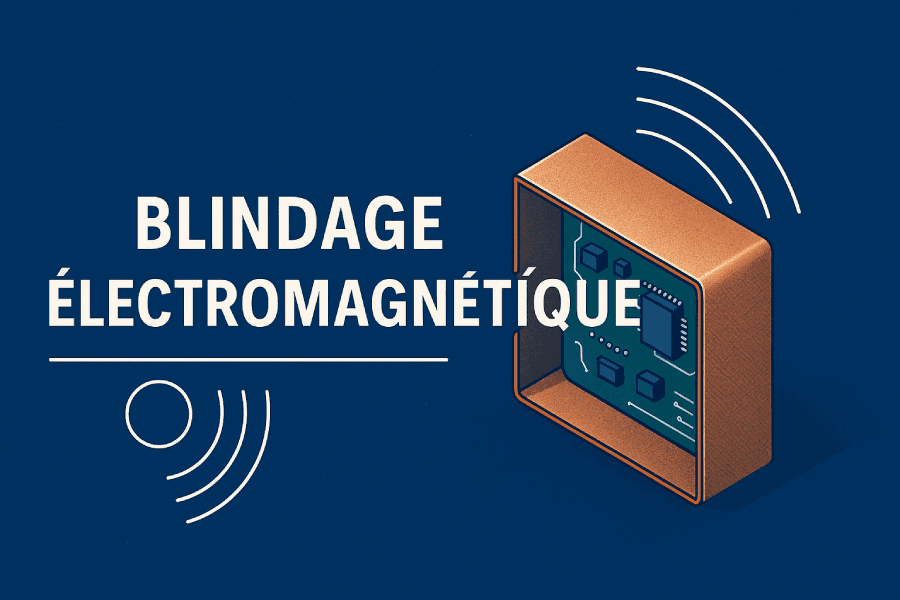
🔎 What is electromagnetic (EMI) shielding?
Electromagnetic shielding, usually called EMI shielding, means placing a conductive barrier between a source of electromagnetic interference and the circuits that have to be protected from it. It works both ways: the shield reduces the outside fields that reach sensitive electronics, and it reduces the noise that a device sends out.
The barrier is a good electrical conductor: a copper, aluminium or steel sheet, a metallised plastic housing, or a conductive gasket where two parts meet. A shield works by reflecting, absorbing or redirecting electric and magnetic fields.
Nearly every fast electronic product uses shielding in some form, from a complete metal enclosure to a small cover placed over one component on a circuit board. This article explains the principle, what a shielding figure in decibels means, the main families of shielding products, and why an enclosure rarely performs as well as the metal it is made of.
🧰 The Faraday cage principle
A conductive enclosure that completely surrounds a volume is called a Faraday cage. When an electric field reaches it, the free charges in the metal move and rearrange themselves so as to cancel the field inside. As long as the charges can move as fast as the field changes, what is inside stays isolated from what is outside.
A car shows the idea on a large scale. In a thunderstorm, the outer metal shell of a hard-topped vehicle protects the people inside, provided the windows are closed: the lightning current travels through the shell and on to the ground.
An electronics enclosure is a Faraday cage with compromises. It needs a door, a display, ventilation and cables, and each of them is an opening in the cage.
📏 Shielding effectiveness: what the decibels mean
Shielding effectiveness (SE) compares the field that arrives at the shield with the field that gets through it, on a logarithmic scale: SE = 20 log (incident field / transmitted field), in decibels (dB).
- 20 dB: the field is divided by 10;
- 40 dB: divided by 100;
- 60 dB: divided by 1,000;
- 100 dB: divided by 100,000.
Two mechanisms add up. Part of the wave is reflected at the surface of the metal: this is the reflection loss. The part that enters the metal is turned into heat as it travels through it: this is the absorption loss, about 8.7 dB for each skin depth of thickness. For a copper foil about 50 µm thick at 100 MHz, the calculation gives 88 dB of reflection and 66 dB of absorption.
Such figures describe the material, not the finished product. Most test equipment has a dynamic range of around 80 to 120 dB, so a calculated value far above 100 dB only means that nothing measurable crosses the metal itself. What an enclosure achieves is decided elsewhere: at its seams, its openings and its cables.
The kind of field matters too. The same gasket does not give the same figure against an electric field, a magnetic field and a plane wave. The data sheet for our knitted wire mesh gaskets, for example, gives 60 to 80 dB for a magnetic field at 100 kHz and 90 to 110 dB for a plane wave at 1 GHz, depending on the alloy.
Two standard methods are used to measure it. ASTM D4935 applies to flat samples of material, for a plane wave between 30 MHz and 1.5 GHz. IEEE 299 applies to complete shielding enclosures whose dimensions are all 2 m or more, from 9 kHz to 18 GHz; IEEE 299.1 covers enclosures and boxes between 0.1 m and 2 m.
⚡ Why shielding matters more than it used to
Computers, medical devices, communication equipment and electric vehicles all pack fast electronics into little space. New technologies, smaller equipment and wider frequency ranges make interference harder to contain.
Shielding helps to:
- 🛡️ protect sensitive circuits, so that they keep working as intended;
- ⚡ limit measurement and control errors, which are a safety matter in a medical device;
- ✅ meet EMC requirements: CE marking in the European Union, FCC rules in the United States, MIL-STD-461 for military equipment, RTCA DO-160 for airborne equipment.
Without it, the magnetic field of a nearby electric motor can be enough to disturb a circuit board.
🏭 Applications in every sector
Shielding is everywhere, even though it is rarely seen:
- 🏥 Medical technology: in a hospital, monitors and infusion pumps work next to phones, Wi-Fi and electrosurgical units; the door of an MRI room carries contact fingers all round its frame.
- ✈️ Aircraft systems: avionics boxes leak through their covers, access panels and connector cut-outs, and weight, fluids, vibration and galvanic compatibility with aluminium all count.
- ⚙️ Industrial control: in a cabinet, variable speed drives, power electronics and communication modules sit side by side; conductive gaskets keep doors and panels electrically continuous with the frame.
- 🚗 Road vehicles and electric mobility: traction inverters, DC-DC converters and on-board chargers are sources of noise, in the same vehicle as radar, cameras and satellite navigation receivers.
Each sector adds its own constraints: shielding level, mechanical strength, weight, temperature.
🧩 The main types of shielding
There is no single shielding product. The main families:
- Conductive gaskets (fabric over foam, metal-filled silicone, knitted metal mesh): they close the gap between two parts of an enclosure, around covers, doors and connector panels, and restore electrical continuity there. A filled silicone gasket can also seal against water and dust; a fabric-over-foam gasket cannot.
- Spring contact fingers in beryllium copper: they ground a door or a panel that is opened often, and keep the current path continuous across the joint.
- Conductive paints and coatings: a plastic housing does not shield by itself; a conductive layer applied to it gives it that function.
- Metal sheets, foils and board-level shields: copper, aluminium or steel, for the walls of an enclosure and for the covers placed directly over components on a circuit board.
- Cable shields: effective only if the shield makes metal-to-metal contact with the enclosure all round the connector.
- Conductive foams: polyurethane foam made conductive through its whole thickness, supplied in sheets a few millimetres thick.
Gaskets and contact fingers can be made to the shape of the part. Four things have to be specified: the shielding level in dB, the frequency range, the compression available and the temperature.
✅ Shielding and EMC compliance
The European directive on EMC (electromagnetic compatibility) sets two essential requirements: equipment must not disturb its surroundings, and it must have enough immunity to work in them. It does not say how to get there. Shielding is one of the mitigation techniques, together with filtering.
A shield does not make a product compliant by itself: compliance is assessed on the finished equipment. A well-chosen gasket contributes to it, and beyond the regulations it reduces the errors and faults that interference causes in service.
📻 A familiar example: the buzz of GSM phones
Anyone who has left a GSM mobile phone next to a pair of computer speakers knows the buzz. A GSM phone transmits in short bursts, one frame every 4.6 milliseconds, and nearby audio circuits pick those bursts up and turn them into sound.
It is a simple picture of what EMC is about: a transmitter doing what it was designed to do, and a neighbouring device without enough immunity to ignore it. Shielding and filtering are the techniques used to give a circuit that immunity.
⚠️ The limits of a shield
No shield is perfect. Several physical effects limit what it achieves in practice:
- Low-frequency magnetic fields: conductive materials are generally poor magnetic shields below a few hundred kilohertz. At kilohertz frequencies and below, the field has to be diverted through a permeable material such as steel or mu-metal, which must go all the way round the object to be protected.
- Skin effect: a field penetrates a conductor only to a limited depth, which shrinks as the frequency rises. In copper the skin depth is about 6.7 µm at 100 MHz but 1.7 mm at 1.5 kHz: a foil is enough at high frequency, not at low frequency.
- Openings: currents must be able to flow freely over the surface of the enclosure. For the same open area, many small holes are much better than a few large ones.
- Seams: often the main leak, because of their length. A seam about half a wavelength long radiates very efficiently, like an antenna. Two metal surfaces simply pressed together rarely make reliable contact at high frequency: oxidation, corrosion and warping get in the way, and screws only make contact at points. This is the job of gaskets and contact fingers.
- Cables: a single unshielded, unfiltered wire passing through the wall can cancel the benefit of the whole enclosure.
The result can be surprising. A metal enclosure with no openings, seams or cable entries can typically reduce radiated emissions by 40 dB or more; with apertures or seams in the wrong place, an enclosure can even radiate more at some frequencies than the same electronics without it.
That is why the performance of a shield depends as much on contacts, electrical continuity and assembly as on the metal.
Electromagnetic shielding is invisible in a finished product, yet it helps to protect signals and data and contributes to the compliance of the equipment. Gaskets and contact fingers are the parts that keep an enclosure continuous at the places where it has to open.
❓ Frequently asked questions
Which metal is most effective for EMI shielding?
Against radio-frequency fields, any good conductor does the job: an enclosure in copper, aluminium or steel would isolate its contents almost perfectly if it had no seams, openings or cable entries. Weight and cost then guide the choice. Against low-frequency magnetic fields, a permeable material such as steel or mu-metal is needed.
Can aluminium foil shield EMI?
As a material, yes. In a good conductor such as copper, a field at 100 MHz penetrates less than 7 µm, so even a thin foil attenuates strongly, and metal foil is among the materials listed for shielding enclosures in IEEE 299. The difficulty is to make it a closed, continuous envelope: every edge left open is a seam that leaks.
How is shielding effectiveness calculated?
As 20 times the logarithm of the ratio between the incident field and the transmitted field, in decibels. For a solid sheet of a good conductor, it is the sum of a reflection loss and an absorption loss. On a real enclosure it is measured, by comparing the field received with and without the shield.
What is the difference between EMI shielding and EMC shielding?
They are the same thing. EMI, electromagnetic interference, is the disturbance; EMC, electromagnetic compatibility, is the aim: equipment that neither disturbs its neighbours nor is disturbed by them. The same shield serves both.