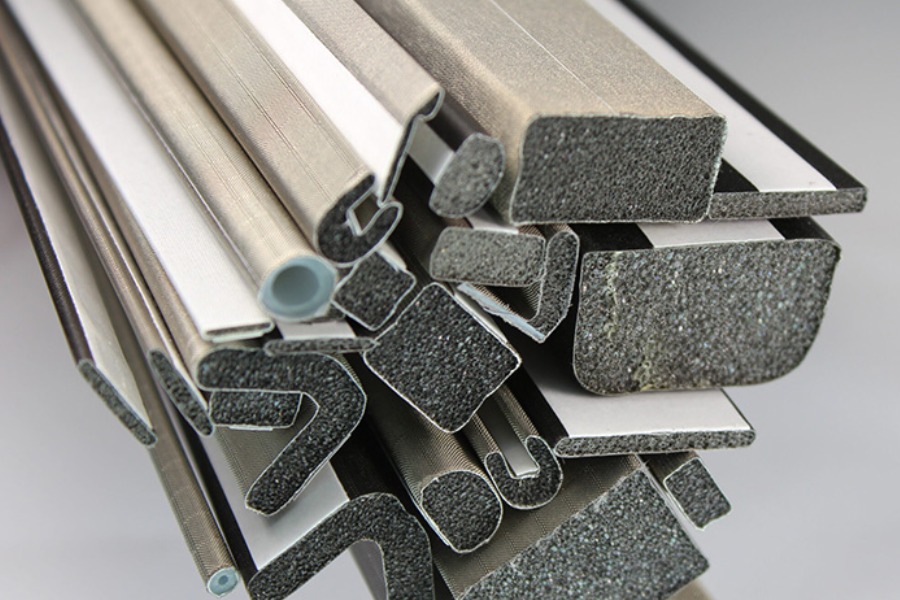
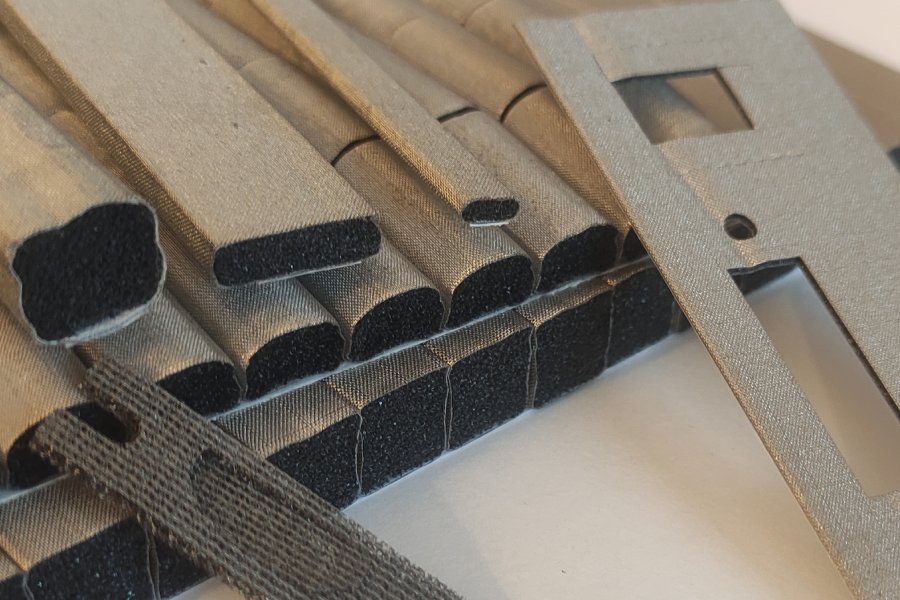
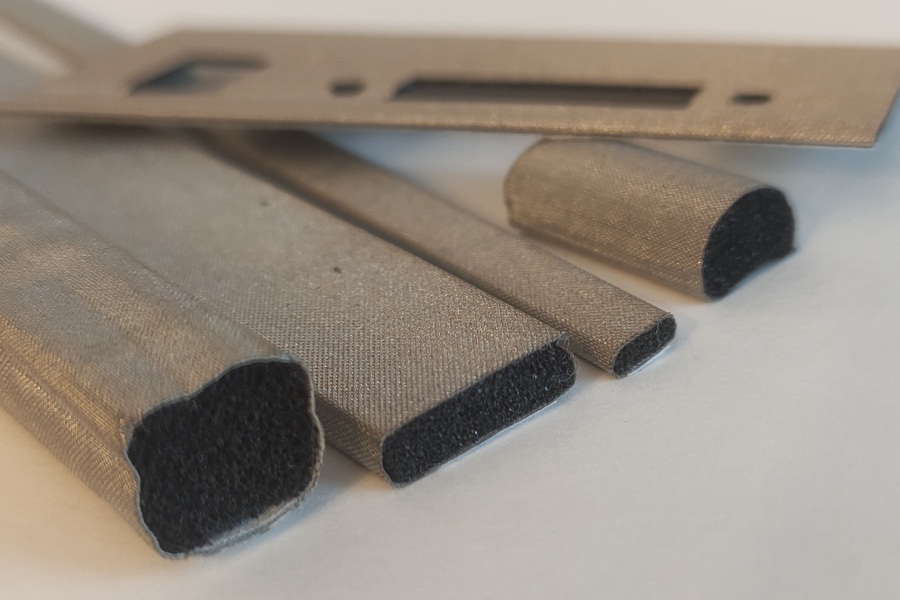
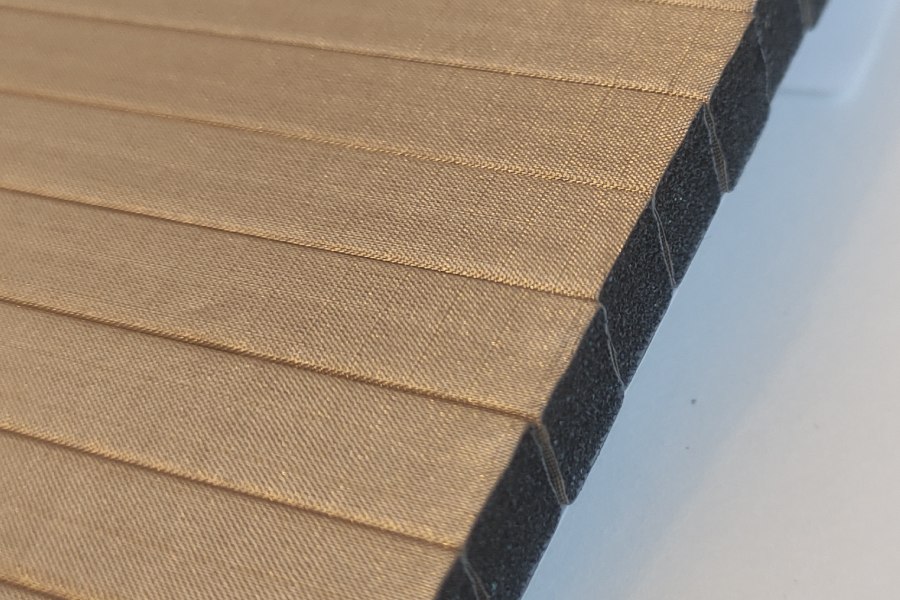
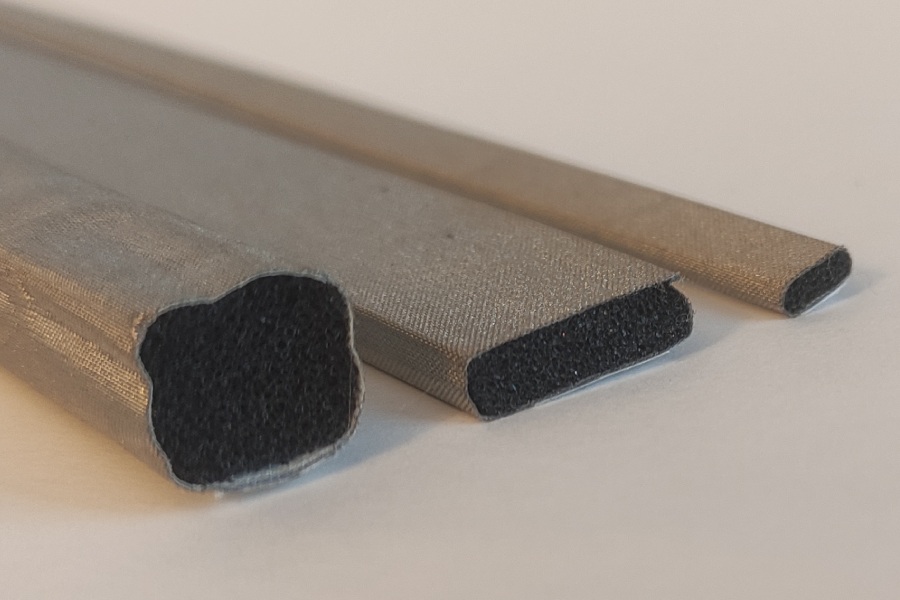
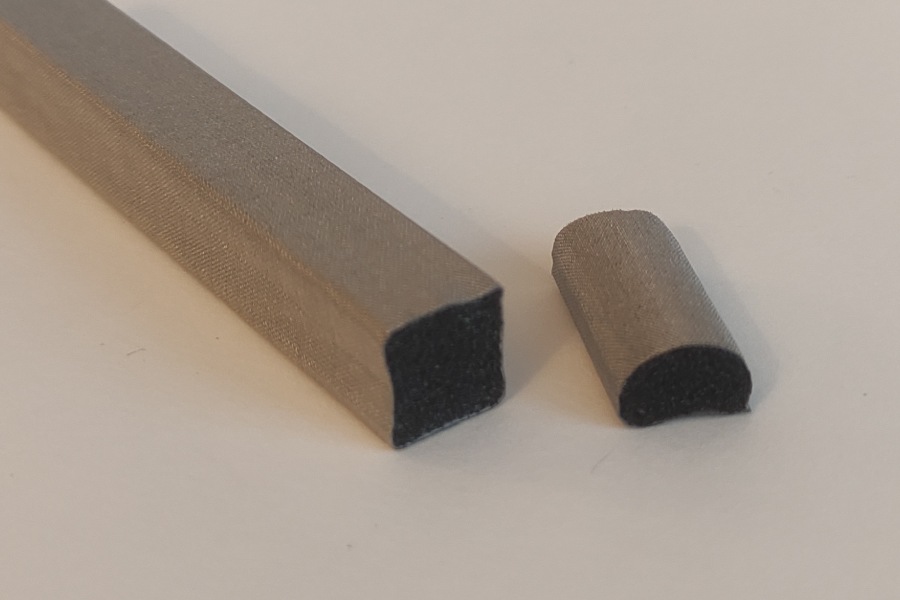
A fabric-over-foam gasket, FOF for short, is a strip of soft polyurethane foam wrapped in a conductive fabric. The foam gives the spring; the fabric carries the current from the door or cover to the frame. Because the foam is so easy to squeeze, the gasket closes the seam of a cabinet, a rack or a thin sheet-metal cover without bending it and without heavy latches.
You will also see it called a conductive fabric gasket or a conductive foam gasket. The second name is slightly misleading: in a FOF gasket the open-cell foam core is not conductive, the nickel-copper fabric around it is. It is an indoor gasket, used on enclosures, electrical cabinets, electronic racks, doors, hatches and connector panels.
✅ Advantages of fabric-over-foam gaskets
- Shielding effectiveness: 60 to 100 dB, depending on the reference and the frequency range. The value for the reference we propose is stated on the quote.
- Low closing force: the gasket compresses with very little effort, so covers and chassis can stay light (aluminium, engineering plastics) and screws can be spaced further apart.
- Low compression set: under 20 %, depending on the reference, for doors and hatches that are opened regularly.
- Simple to fit: supplied with or without adhesive backing, easy to position, and easy to cut for screw holes or mitred corners.
- Forgiving on tolerances: the foam takes up uneven gaps, which avoids machining a precise groove just to hold the gasket.
- Flame rating: UL94 V-0.
🔧 Technical specifications
- Core: open-cell polyurethane foam.
- Conductive covering: nickel-copper fabric as standard; black conductive fabric or aluminium foil on request.
- Surface resistance: ≤ 0.05 Ω/inch (100 g load).
- Recommended compression: 30 to 50 % of the height for D and rectangular profiles, 50 to 75 % for C profiles.
- Compression set: under 20 %, depending on the reference.
- Adhesive strength: ≥ 1.3 kg/25 mm. Non-conductive adhesive: initial adhesion 1,600 g/25 mm, holding power 1,440 min/inch.
- Flammability: UL94 V-0.
- Operating temperature: −10 °C to +110 °C (down to −40 °C depending on the reference).
⚡ Nickel-copper fabric as standard
Most FOF gaskets are covered with a fabric metallised with copper and nickel. Copper provides the conductivity; the nickel layer on top protects it from corrosion and wear. That combination is why a surface resistance of 0.05 Ω per inch or less can be kept when the door is opened again and again.
Nickel-copper also sits well against the usual chassis materials, aluminium and steel, which limits the risk of galvanic corrosion at the contact line. A black conductive fabric or an aluminium foil covering can be supplied for specific needs; tell us what the gasket will touch and we take it into account.
📐 Profiles and shapes
- Rectangular and square strips: the general-purpose profile for flat flanges, doors and panels.
- D profile: a rounded contact face that closes with even less force.
- C, P and bell profiles: for edges, lips and seams where a flat strip cannot be bonded.
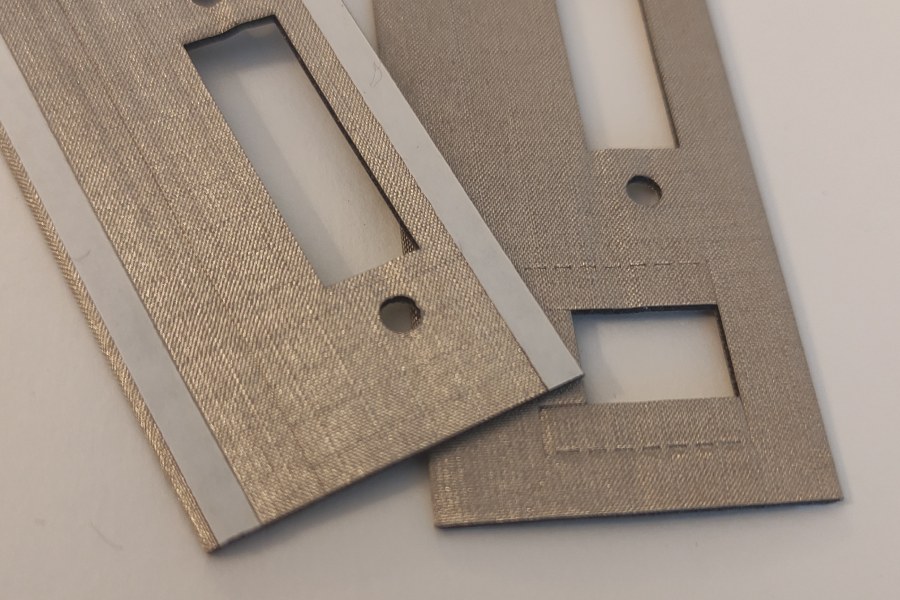
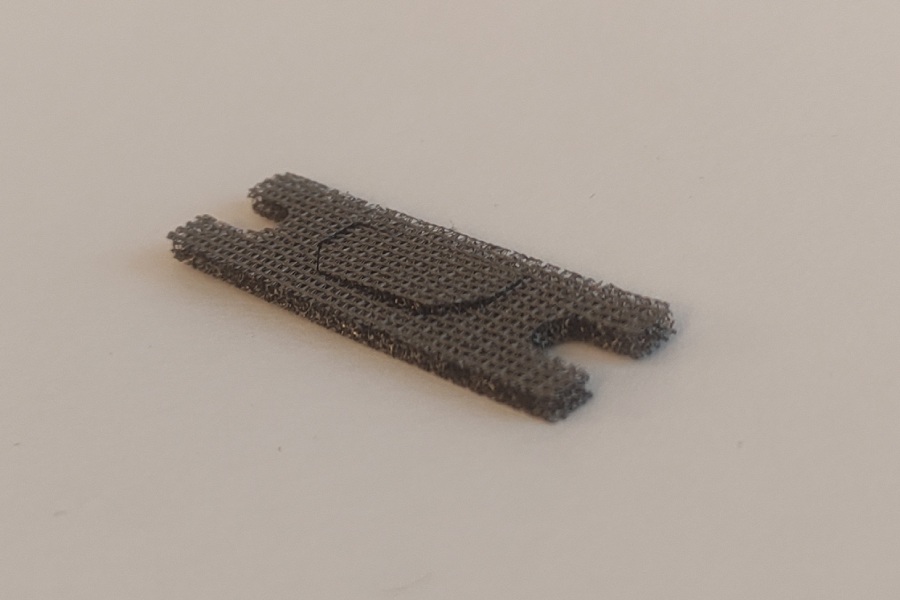
- I/O and D-SUB gaskets: flat parts cut to your drawing, with the connector openings, for back panels and connector plates.
- Cut lengths and die-cut parts: strips cut to length, with or without adhesive, holes and notches included.
🛠️ Gaskets made to your specification
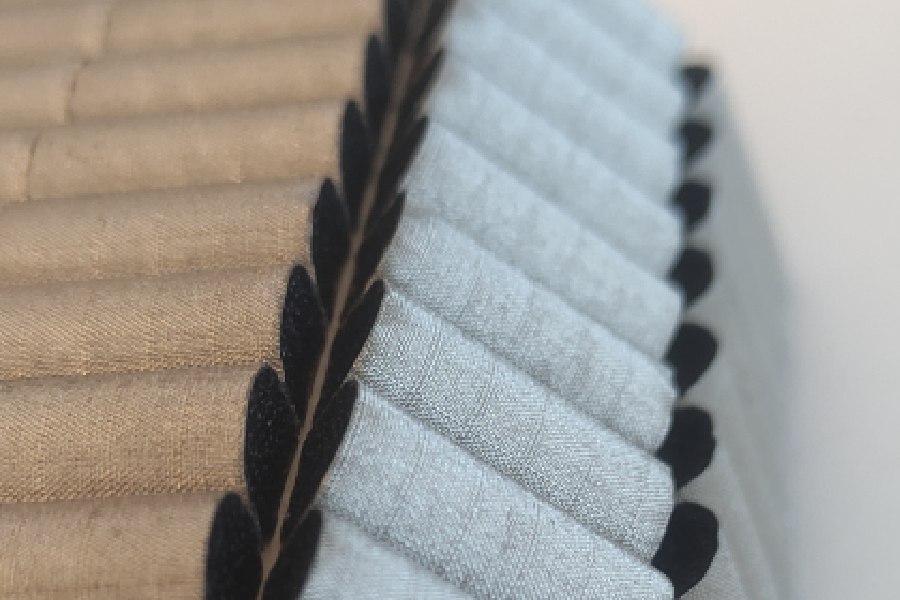
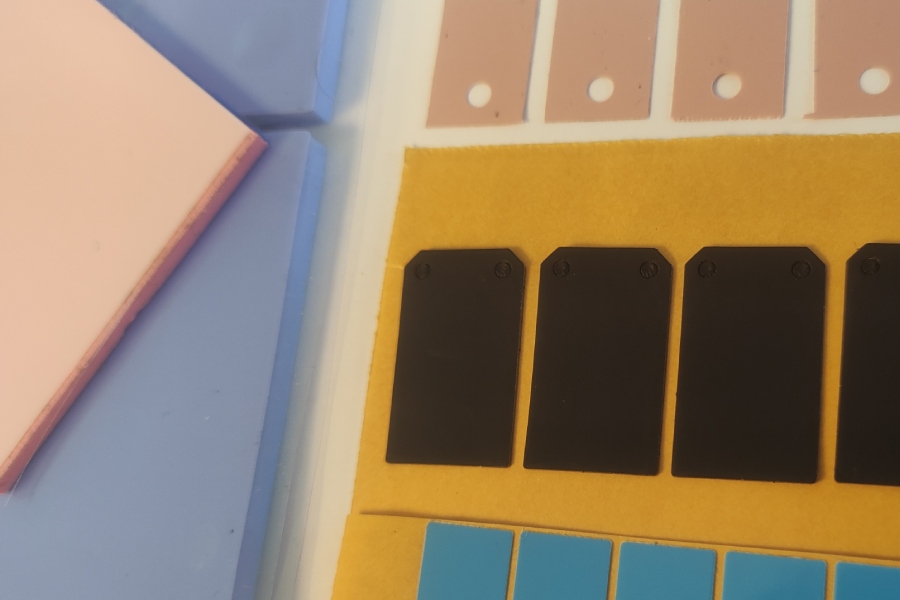
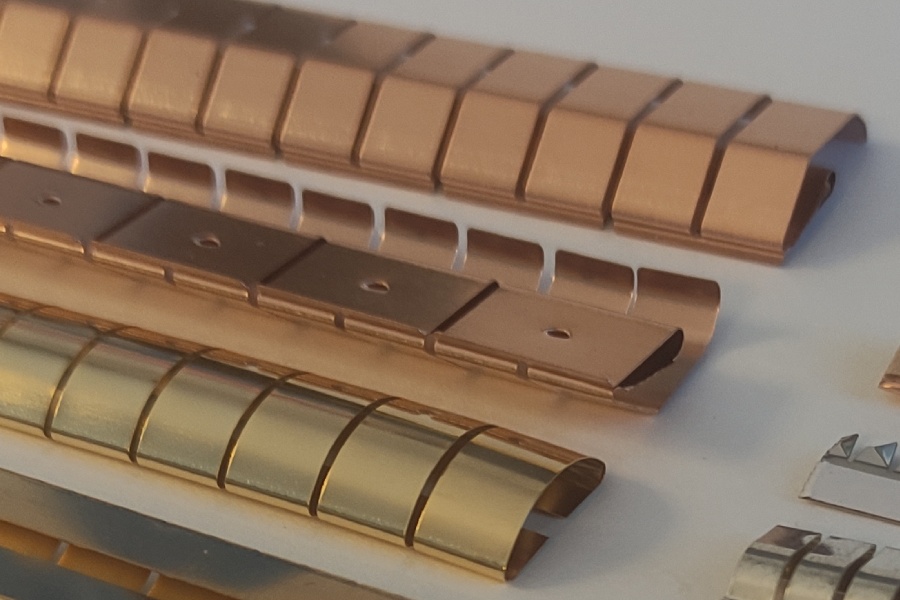
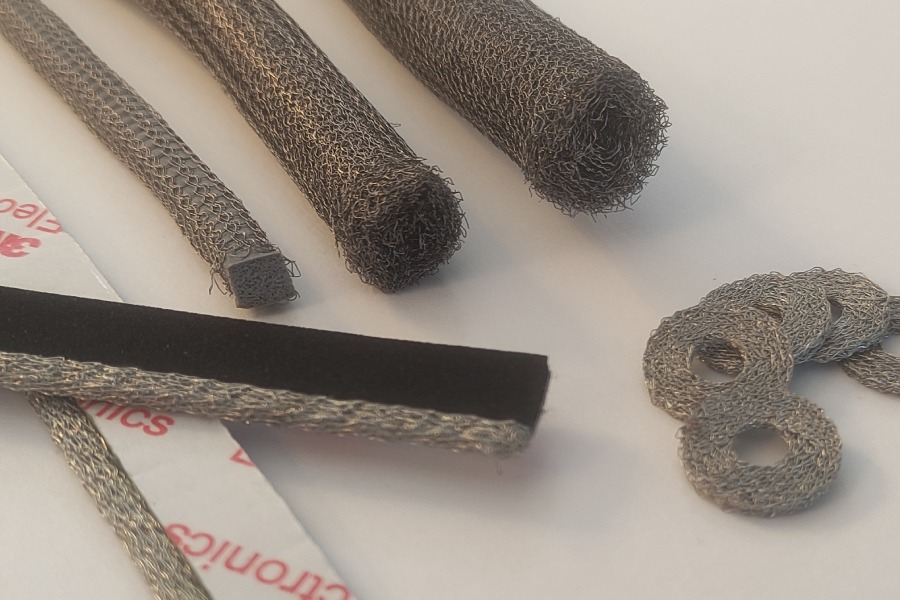
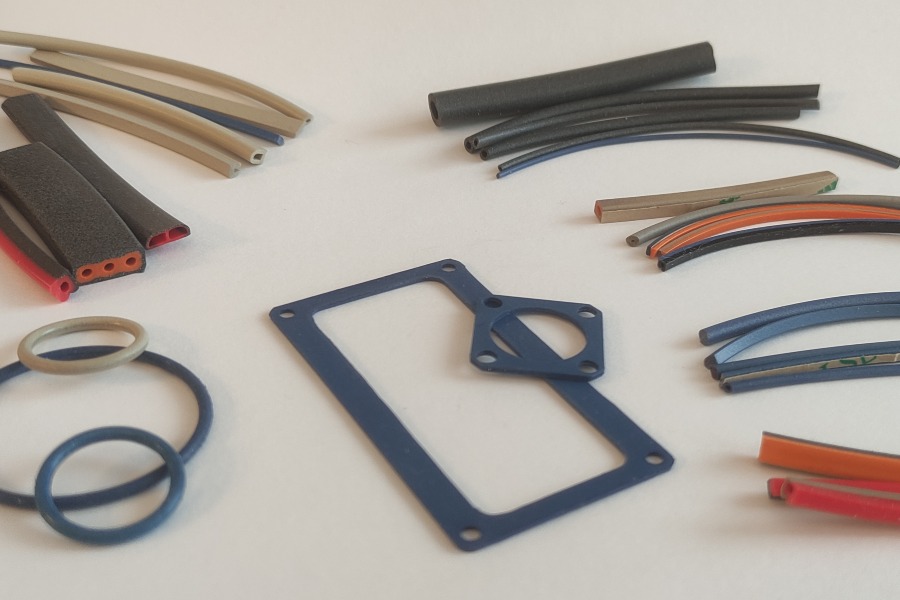
Fabric-over-foam is a made-to-order product more than a catalogue one: the section, the height, the length and the cut-outs are set by your enclosure, and a great many shapes are possible. The photos on this page show some of the parts we have supplied. If your seam calls for another section, another height, a different covering, a conductive adhesive, a wider temperature range or a part cut to a drawing, send us the dimensions or the plan and what the gasket has to do. We look for the reference that fits and send its datasheet with the quote. This applies to a handful of prototype parts as much as to a production run.
📏 Compression and mounting
A FOF gasket works over a wide range of compression, which is its main practical advantage over a solid conductive elastomer: 30 to 50 % of its free height for a D or rectangular strip, and as much as 50 to 75 % for a C profile. Choose the height so that the largest gap of your seam still compresses the gasket by about a third, and check that the smallest gap does not crush it flat.
With adhesive backing the strip is simply bonded to a clean, dry, degreased surface. The adhesive holds the gasket in place; the electrical contact is made by the fabric pressed between the two metal faces, so both faces must be bare or have a conductive finish. Paint or anodising under the gasket breaks the shield.
🛡️ Resistance and service life
The metallised fabric resists abrasion and corrosion, and the foam recovers its shape after each opening as long as the gasket is not over-compressed. A fabric-over-foam gasket is not a weather seal: open-cell foam lets water through. It is intended for indoor equipment. Where the same joint must keep out water or dust, a conductive silicone gasket is the right choice.
📋 Typical applications
- Electronic enclosures: covers, lids and access panels.
- Electrical cabinets and racks: doors, hatches and removable panels.
- Connector panels: D-SUB and I/O gaskets, control panels.
- Telecoms, medical equipment, aerospace and on-board electronics: wherever a light cover has to be shielded without a heavy closing mechanism.
🏭 Storage
Keep FOF gaskets between 10 and 25 °C, below 60 % relative humidity, away from direct light and chemicals. With adhesive backing, shelf life is generally 12 to 24 months depending on the reference; it is stated at delivery.
Not sure which height or profile suits your seam? You can order a sample of 3 pieces, cut for your application, and check the compression, the closing force and the shielding on your own enclosure before production.
❓ Frequently asked questions
What is a fabric-over-foam gasket?
A soft EMI gasket made of a polyurethane foam core wrapped in a conductive fabric, usually nickel-copper. It restores electrical contact across the seam of a metal enclosure with very little closing force.
Can foam conduct electricity?
Ordinary foam cannot. In a FOF gasket the conduction comes from the metallised fabric around the foam, not from the foam itself.
Is a foam gasket waterproof?
No. A fabric-over-foam gasket shields against interference but does not seal against water. It is designed for indoor equipment.
How much should a FOF gasket be compressed?
About a third to a half of its height for a D or rectangular section; a C profile takes more, 50 to 75 %.
When should I choose FOF rather than a conductive elastomer?
When the cover is light, the closing force is limited or the gap varies along the seam, and the equipment stays indoors. For high temperatures or water sealing, an elastomer is better suited.
Is the adhesive conductive?
The standard backing is a non-conductive adhesive that only holds the gasket in place. A conductive adhesive can be requested; say so in your enquiry.
Can you supply I/O or D-SUB gaskets to our drawing?
Yes. Send the drawing with the connector openings and the thickness you need.
Which shielding level can I expect?
Between 60 and 100 dB; it varies with the reference and with the frequency band. The figure for the proposed reference is on the quote, and the result on your equipment depends on the seam, the surfaces and the compression.
Can I get a profile or size that is not listed?
Yes. Give us the section, the height and the length, or a drawing, and we propose a matching reference with its datasheet.
Can I test a sample first?
Yes. A sample of 3 pieces lets you check fit and closing force in your own assembly before ordering.
Do you deliver small quantities?
Yes, from prototypes to series. The lead time depends on the reference and is confirmed on the quote.
Other shielding and thermal products
Characteristics and values are given for guidance only. See our terms of sale for details. For any critical application, please contact us.