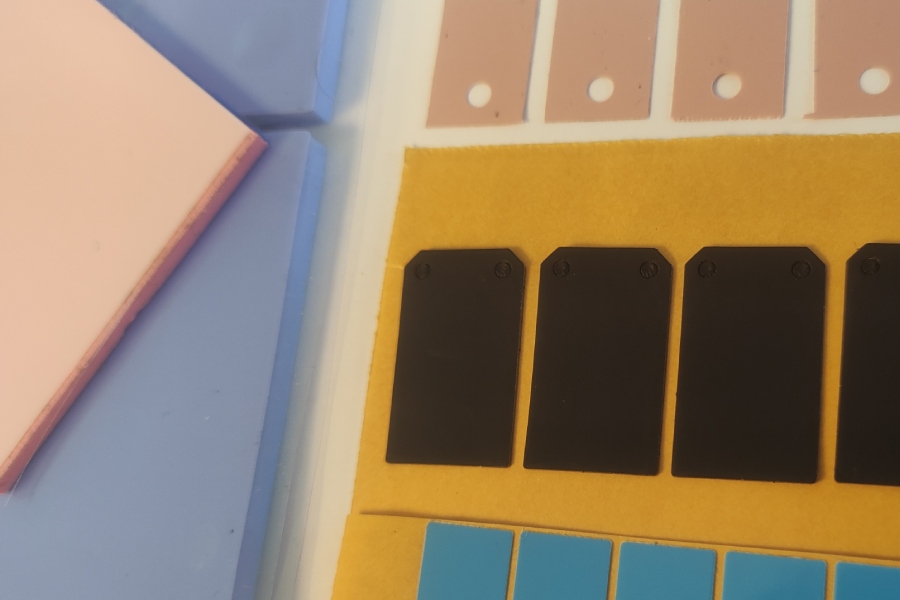
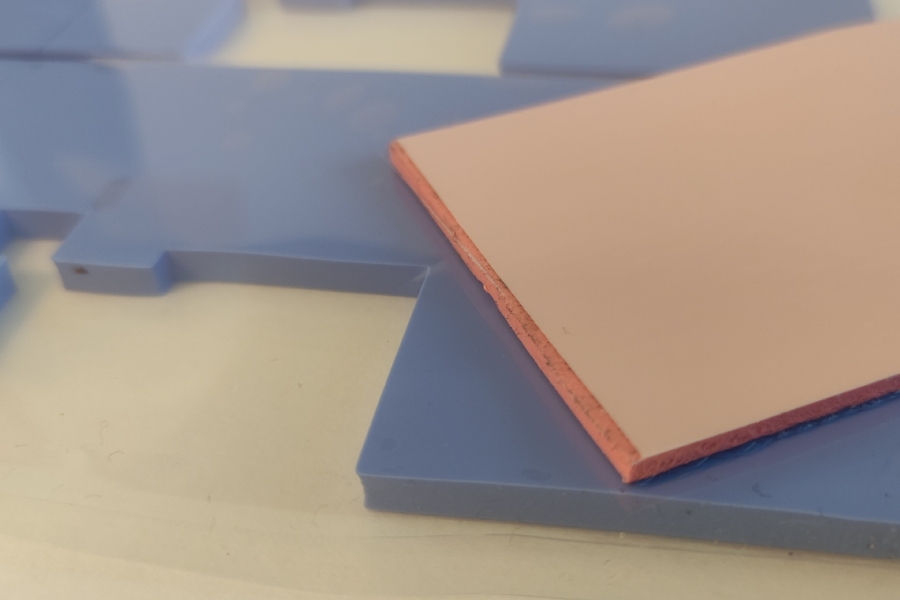
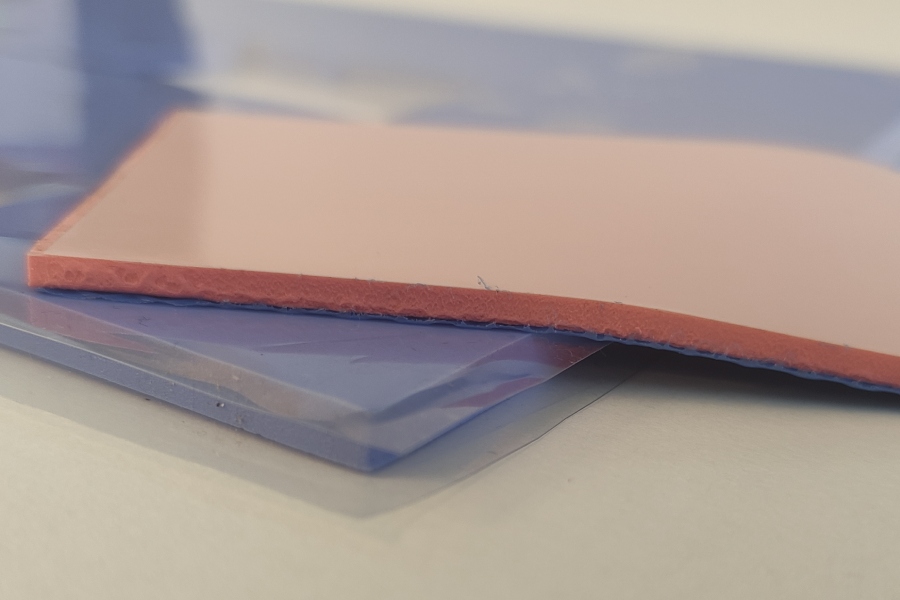
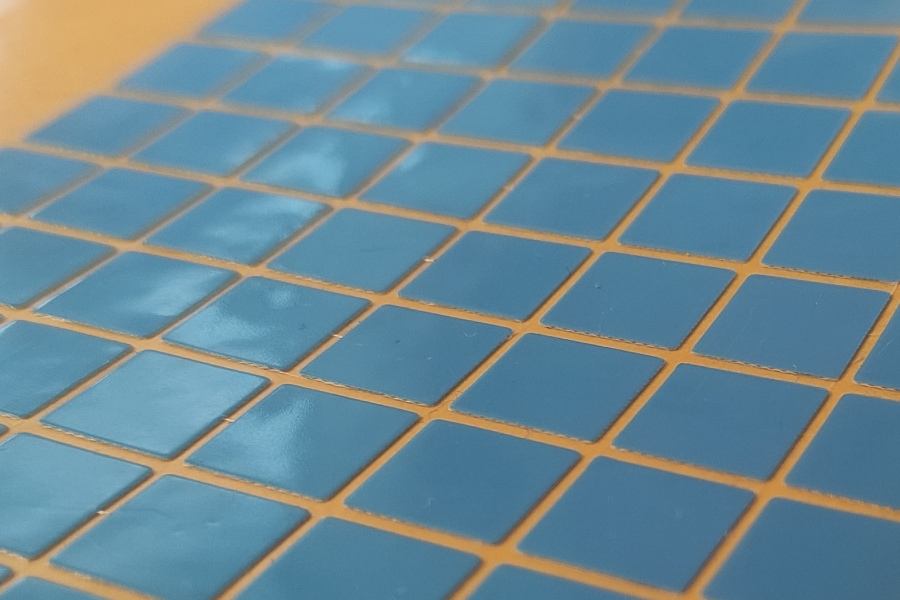
A silicone thermal pad sits between a hot component and its heat sink, or between a circuit board and a metal housing. Without it, the gap between the two parts is full of air, and air is a poor conductor of heat. The pad fills that gap with a soft silicone loaded with thermally conductive fillers, so heat leaves the component instead of building up around it.
These pads are often called thermal interface material (TIM), thermal gap pads or gap fillers. Unlike thermal paste, they are solid sheets: you cut them, place them and assemble, with nothing to spread and nothing to clean. They also absorb differences in height between components, which paste cannot do, and in their standard form they insulate electrically.
Standard versions, and pads built to your specification
We supply two standard grades. The 3 W/m·K version (EDP-TH30) covers the widest range of thicknesses, from 0.3 to 15 mm, and is very soft (Shore 00 25 ± 5). The 5 W/m·K version (EDP-TH50) moves more heat through the same thickness and is offered from 0.3 to 5 mm, slightly firmer at Shore 00 35 ± 5. Both work continuously from −40 °C to +220 °C and are rated UL 94 V-0.
These two grades are a starting point, not a limit. Tell us what your project needs – thermal conductivity, thickness, hardness, insulation or electrical conductivity, temperature range, adhesive face, reinforcement, shape and quantity – and we look for the reference that matches it. Lower, intermediate and higher conductivities, other thicknesses and softer or firmer grades can all be requested; the datasheet of the proposed reference comes with the quote.
Key properties
- Thermal conductivity: 3 or 5 W/m·K depending on the version, other values on request.
- Electrical insulation: breakdown voltage of at least 4 kV/mm for EDP-TH30 and 5 kV/mm for EDP-TH50.
- Fire rating: UL 94 V-0.
- Operating temperature: −40 °C to +220 °C; the EDP-TH30 grade loses no more than 1 % of its mass after 200 hours at 200 °C.
- Softness: Shore 00 25 to 35, so the pad follows uneven surfaces without putting stress on fragile components.
- Formats: 400 × 200 mm sheets, or parts cut to your drawing.
Choosing the thickness
The gap decides the pad, not the other way round. Measure the distance between the component and the heat sink at its largest, tolerances included, and pick a pad slightly thicker than that gap. Once assembled, the pad is compressed in every case, and that compression is what gives good contact on both faces. A pad thinner than the gap leaves an air layer; a pad far too thick needs a high clamping force and pushes on the component.
Where several components of different heights share one heat sink, a single soft pad can often cover them all. Send us the gap values and the clamping arrangement with your request: the compression range of the reference we propose is given with the quote.
What the W/m·K figure does not tell you
Thermal conductivity describes the material, not your assembly. The heat has to cross the whole thickness of the pad, plus the two contact surfaces, so a thin 3 W/m·K pad can perform better than a thick 5 W/m·K pad. In practice, keep the pad as thin as the gap allows, and move to the higher grade when the gap is small and the power density is high.
Thermal pad or thermal paste?
Paste gives the thinnest layer, which suits two flat, rigid surfaces clamped tightly together, such as a processor and its cooler. A pad is the better choice when there is a real gap to fill, when several parts of different heights share one heat sink, when the assembly must stay clean and repeatable in production, or when the two surfaces must stay electrically isolated. Pads also stay in place over time, where paste can be squeezed out by repeated heating and cooling.
Insulating as standard, conductive on request
Our standard pads insulate: they carry heat but not current, so the component stays electrically isolated from the heat sink or the housing. For enclosures that need both heat transfer and electrical continuity, electrically conductive versions can be supplied for specific needs. They are often used alongside EMI shielding gaskets in the same housing.
Formats, custom cutting and samples
- Standard sheets: 400 × 200 mm.
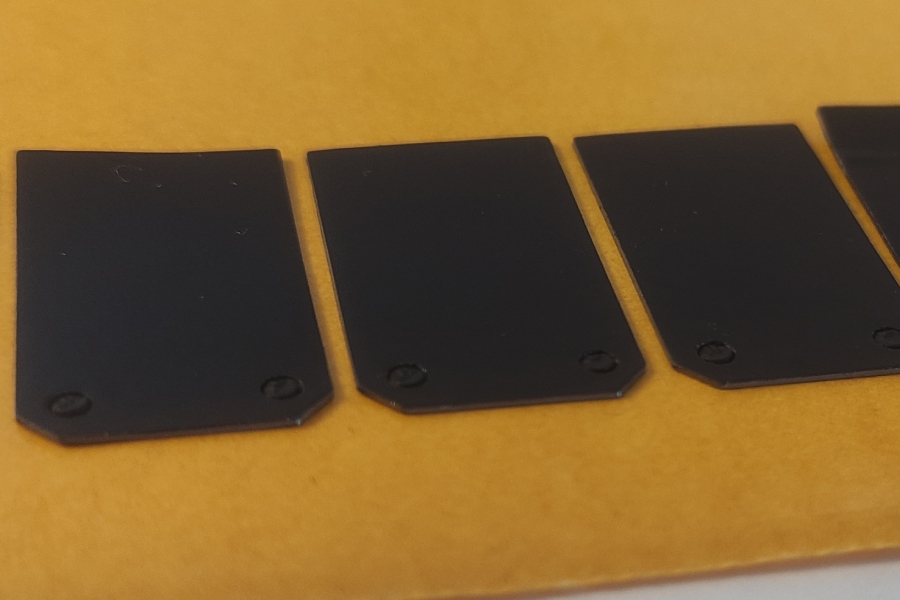
- Custom cutting: any size or shape, including strips, washers and spacers, delivered as sheets or as parts ready to fit.
- Adhesive-backed or fibreglass-reinforced pads: available on request.
- Small series welcome: from a sample to production runs. Give us the delivery date you need; the lead time is confirmed on the quote.
Before you commit, you can order a sample of 3 pieces to check the fit, the compression and the temperature reached in your own assembly.
Where silicone thermal pads are used
- Power electronics: converters, IGBT modules, power supplies.
- LED lighting: high-power LEDs and LED modules.
- Automotive: control units, engine management systems and other on-board electronics.
- Telecoms: routers, modems, 5G base stations and network equipment.
- Computing: processors, graphics processors, memory and storage modules.
- Demanding sectors: medical devices (MRI, scanners), aerospace and defence.
- Industrial equipment that dissipates a lot of heat, where lower temperatures make assemblies more reliable.
Frequently asked questions
What does a thermal gap pad do?
It fills the space between a heat source and a heat sink, or a metal case, so heat crosses the gap by conduction instead of being trapped by air.
Are thermal pads electrically conductive?
Ours are not, in their standard form: they insulate, and the datasheet of each grade gives its breakdown voltage. Electrically conductive versions exist and can be supplied on request.
Should I use a thermal pad or thermal paste?
Paste for two flat surfaces pressed tightly together; a pad when there is a gap to fill, when heights vary, or when the parts must stay insulated from each other.
How thick should my thermal pad be?
Slightly thicker than the largest gap, tolerances included, so it is compressed once assembled. Our pads start at 0.3 mm and go up to 15 mm in the 3 W/m·K grade.
What thermal conductivity do I need?
It depends on the power to remove and on the gap. We supply 3 and 5 W/m·K as standard; a thinner pad often matters as much as a higher figure.
Can you cut pads to my drawing?
Yes. Send a drawing or dimensions and we supply finished parts, or full 400 × 200 mm sheets if you prefer to cut them yourself.
Do you supply adhesive or reinforced pads?
Yes, on request: an adhesive face makes positioning easier, and a fibreglass reinforcement helps when handling very thin pads.
What temperature range do they handle?
Both grades are rated for continuous use from −40 °C up to +220 °C.
Can I test a sample first?
Yes. A sample of 3 pieces lets you check fit, compression and temperatures in your own assembly before ordering.
Can you supply a pad that is not in your table?
Yes. Send us the characteristics you need and we propose a matching reference with its datasheet.
Do you deliver small quantities?
Yes. Small series are welcome, from a single sample to production; the lead time depends on the reference and the cutting, and is confirmed on the quote.
| Reference | Thermal conductivity | Thickness | Colour | Hardness (Shore 00) | Operating temperature |
|---|---|---|---|---|---|
| EDP-TH30 | 3 W/m·K | 0.3 – 15 mm | Blue/Grey | 25 ± 5 | −40 → +220 °C |
| EDP-TH50 | 5 W/m·K | 0.3 – 5 mm | Blue/Grey | 35 ± 5 | −40 → +220 °C |
| Test item | Method | Unit | Value |
|---|---|---|---|
| Size (standard sheet) | ASTM D1204 | mm | 400 × 200 |
| Colour | Visual | — | Blue, grey |
| Thickness available | ASTM D374 | mm | 0.3 – 15 |
| Density | ASTM D792 | g/cm³ | 3.0 |
| Hardness | ASTM D2240 | Shore 00 | 25 ± 5 |
| Tensile strength | ASTM D412 | kN/m | 2.3 |
| Breakdown voltage | ASTM D149 | kV/mm | ≥ 4.0 |
| Volume resistivity | ASTM D257 | Ω·cm | 1.7 × 10¹³ |
| Continuous operating temperature | EN344 | °C | −40 → +220 |
| Mass loss (200 °C, 200 h) | — | % | ≤ 1 |
| Fire rating | UL 94 | — | V-0 |
| Thermal resistance | ASTM D5470 | °C/W | 0.25 |
| Thermal conductivity | ASTM E1461 | W/m·K | 3.0 |
Other shielding and thermal products
Characteristics and values are given for guidance only. See our terms of sale for details. For any critical application, please contact us.