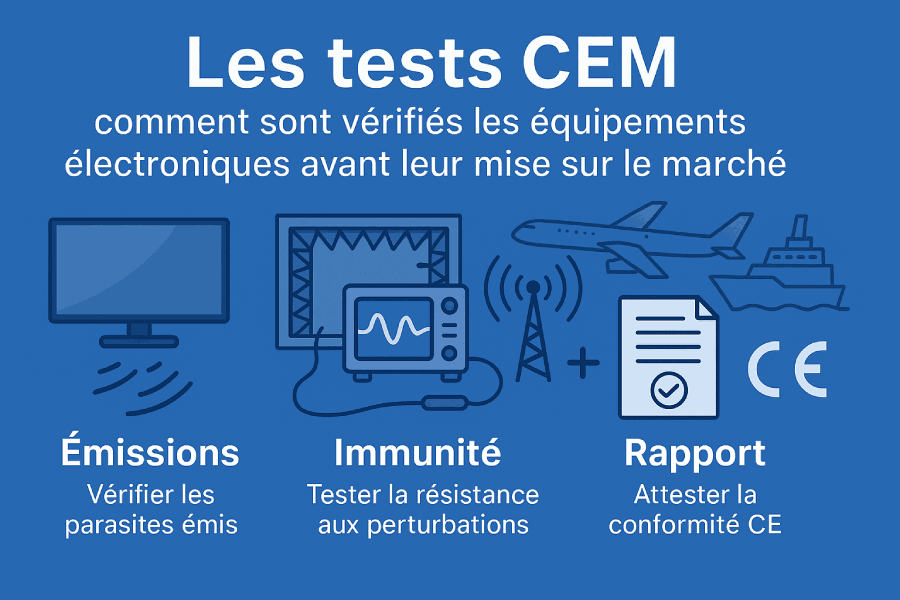
Electromagnetic compatibility, or EMC, is now part of the work of every electronics manufacturer. Before it is placed on the market, electrical and electronic equipment has to be assessed on two counts: it must not disturb its surroundings, and it must withstand the disturbances it will meet there.
EMC testing is how that is checked. This article explains what a test consists of, what the rules actually require, and what can be done when a product fails.
🔍 What is an EMC test?
An EMC test evaluates an electronic device from two sides: it measures the interference the device emits, and it checks that the device keeps working when interference is applied to it. Emissions, radiated and conducted, have to stay within defined limits.
- 💡 Emission: does the equipment produce interference that could affect other devices?
- 🛡️ Immunity: does it go on working correctly when it is exposed to external disturbances?
In the European Union, the reference is the EMC Directive 2014/30/EU. The directive sets the two essential requirements; the limits and the test methods are found in the standards that go with it, such as EN 55032 for emissions or EN 61000-4-2 for electrostatic discharge.
⚙️ Why EMC tests matter
Electromagnetic interference can cause:
- intermittent faults,
- measurement errors,
- and serious malfunctions in medical, automotive or aerospace systems.
That is why EMC is more than paperwork. The directive requires the manufacturer to carry out an electromagnetic compatibility assessment of the apparatus and to declare, on his sole responsibility, that it meets the requirements. Equipment that conforms to the harmonised standards is presumed to conform to the directive, which is why testing to those standards is the usual route, and why skipping it is generally seen as a high-risk choice.
🧩 Tests in every field
EMC tests are not only for everyday electronics such as televisions, computers and chargers. They also apply to far more critical equipment: avionics, shipboard systems and medical electrical equipment.
Beyond the final verdict, a test shows where a design is weak while there is still time to correct it. Many manufacturers therefore run pre-compliance checks during development, before the formal test.
🧪 The main steps of an EMC test
The tests are carried out in specialised laboratories. Radiated measurements are made with antennas in an anechoic or semi-anechoic chamber. The methods come from the international standards of the IEC, published in Europe as EN standards.
1. Preparing the sample
The product is set up in a configuration representative of its intended use, with its power supply, its cabling and its enclosure. The directive asks for the assessment to cover all normal operating conditions.
2. Measuring emissions
Radiated emissions are the energy the device sends into the air; conducted emissions are the noise that travels along its power and signal lines, typically below 30 MHz. Both are compared with the limits of the applicable standard, EN 55032 for multimedia equipment for example.
3. Immunity tests
Disturbances are then applied to the product to see how it behaves: a radio-frequency field (EN 61000-4-3), electrostatic discharges (EN 61000-4-2), fast transients in bursts (EN 61000-4-4), and surges that simulate events on the power line.
4. Results and report
The laboratory issues a report that gives the results of each test and lists any non-conformities to be corrected.
🧰 Which products help when a test fails?
To correct the problems found during testing, engineers usually turn to established shielding techniques. The most common:
- Conductive EMI gaskets: they restore electrical continuity between two metal surfaces.
- Beryllium copper finger gaskets: they ground covers and hatches that are opened often.
- Foam gaskets with a conductive fabric cover (fabric-over-foam): for the light covers and removable panels of electronic enclosures.
- Filters on the cables, which limit the noise that travels along them.
💡 ElectroDome supplies these gaskets: see our range of EMI shielding gaskets. A gasket matched to the joint contributes to the compliance of the equipment; the result is confirmed by the test itself.
🧭 Where can an EMC test be done?
EMC tests are offered by accredited laboratories; the accreditation body is UKAS in the United Kingdom and Cofrac in France. Intertek, DEKRA, Element and Nemko, for example, all provide EMC testing. The time needed depends on the product and on the tests required: ask the laboratory for it when you book.
🧠 Plan ahead, design better
Manufacturers who take EMC constraints into account from the design stage, and who check their prototypes before production, avoid late redesigns and reach the market sooner. A large study by Intertek put the share of products that pass EMC testing first time at only about half.
EMC tests are more than a regulatory step: they show that your equipment can work alongside its neighbours without interference.
❓ Frequently asked questions
Is EMC testing mandatory?
The EMC Directive does not make laboratory testing mandatory as such. It requires the manufacturer to assess the electromagnetic compatibility of the apparatus and to declare its conformity. Testing to harmonised standards is the usual way to do this, because conformity with them gives a presumption of conformity with the directive.
What is the difference between emissions and immunity testing?
Emissions testing measures the interference a device produces. Immunity testing checks that the device keeps working when interference is applied to it.
What is pre-compliance testing?
Checks made during development, before the formal test, to find likely causes of failure while the design can still be changed.
What is an anechoic chamber?
A shielded room lined with material that absorbs radio waves. It is where radiated emissions are measured with antennas, away from outside signals and reflections.