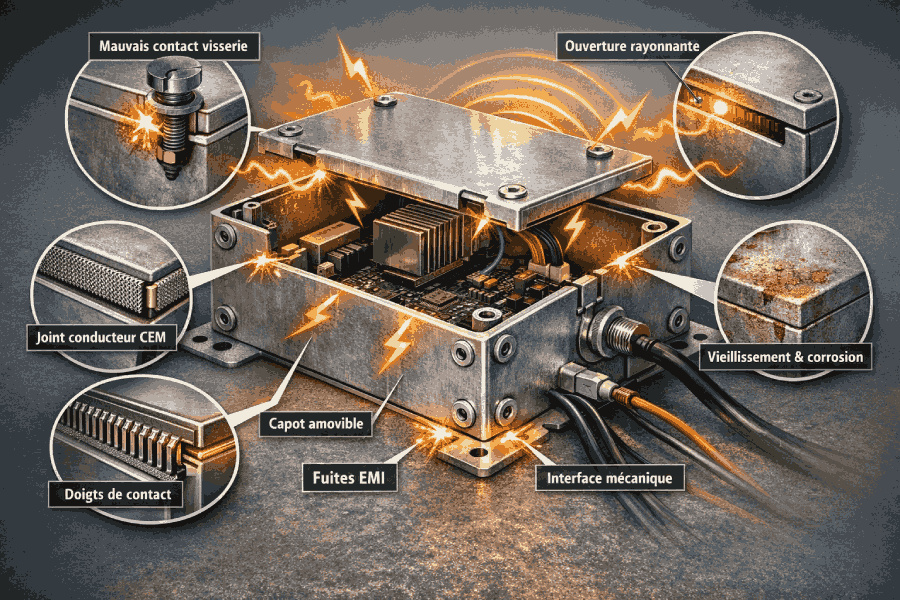
A metal enclosure looks like a natural shield against electromagnetic interference. On paper it is: a metal box with no openings, seams or cable entries can typically reduce radiated emissions by 40 dB or more. A real enclosure has all three, and its performance is decided at the places where its parts meet. It is one of the first places to look after a failed EMC test.
This article looks at where an enclosure leaks, why surface finishes matter as much as the metal, and which parts restore electrical continuity across a joint.
🔎 Why a metal enclosure is not always enough
Breaks in continuity that cannot be seen
For a shield to work, currents must be able to flow freely over its surface. An enclosure machined from solid aluminium or folded from steel sheet conducts very well, but it is built from several parts: a body, a cover, a door, panels. Every line where two parts meet interrupts those currents, unless the parts are in good electrical contact along its whole length.
Joints, gaps and surface finishes
Covers, panels and hatches are fitted with:
- the mechanical clearance needed for assembly;
- paint, anodising or another protective finish;
- screws, which make good contact at points but not necessarily between them.
Two metal surfaces simply pressed together rarely make a reliable contact at high frequency: oxidation, corrosion and warping all reduce its quality. The finish adds to the problem. The layer produced by anodising is aluminium oxide, which does not conduct, and paint or varnish on a contact face has the same effect.
These details raise the contact impedance between the parts of the enclosure and lower its shielding effectiveness, whatever the metal. Our article on how a shield works explains what that figure means.
📍 Where an enclosure leaks
Removable covers and panels
Joints that can be taken apart come first. Seams are often the main leak of an enclosure because of their length: a seam about half a wavelength long can be a very efficient radiator, much like a half-wave dipole antenna. At 1 GHz the wavelength in air is 30 cm, so 15 cm of seam without contact is enough.
Maintenance hatches and doors
A hatch opened for servicing, adjustment or module replacement has to make contact again every time it is closed. Its contact faces get dirty and wear, so it calls for a contact designed for repeated use.
Mechanical interfaces and assemblies
Chassis, rails, mounting plates, sub-assemblies: all the metal parts of a cabinet, frame, panels, roof and door, should be bonded to one another. Each interface left to chance is a possible break in the shield.
🔗 Electrical continuity and EMC performance
Contact impedance and shielding effectiveness
The shielding of an enclosure does not depend only on the conductivity of its metal. It depends above all on a low contact impedance between all its metal parts. Screws and rivets show the point: each gives a good contact where it sits, without improving the connection between two fasteners. Two techniques lower the impedance of a seam: overlapping the two edges, and fitting finger stock or a gasket.
The effect of frequency
As frequency rises, the wavelength shrinks, and a seam that had no effect on older, slower equipment can start to behave like a slot antenna. An opening hardly disturbs the surface currents as long as its largest dimension is much smaller than the wavelength; that condition gets harder to meet as frequency goes up.
⚙️ Mechanical and industrial constraints
Assembly tolerances
Two surfaces that look flat still leave gaps between them. The part that restores continuity has to take up that unevenness, and the dimensional spread of machining and assembly, without losing contact. That is what a compressible gasket does.
Where the equipment is installed
In industrial cabinets, variable speed drives, power electronics and communication modules share one enclosure, and the door, the panels and the frame have to stay electrically continuous. Outdoors or near the sea, corrosion comes first: where the filler of the gasket and the metal of the flange form a galvanic couple, the flange can be attacked.
Temperature
Gasket materials do not all cover the same range. Depending on its filler, a conductive silicone works from −55 °C up to +125 °C or +200 °C; a fabric-over-foam gasket from −10 °C to +110 °C, and down to −40 °C for some references.
Maintenance and dismantling
A joint that is opened often must keep its performance after many opening and closing cycles. An all-metal knitted mesh gasket takes a compression set and is not meant for frequent opening; beryllium copper fingers are made for it.
🛡️ What is used to keep an enclosure continuous
Conductive gaskets
Silicone gaskets loaded with metal particles give a continuous electrical path between two metal faces while taking up the gaps. With suitable compression they also seal against water and dust, so that one part does both jobs on an outdoor enclosure.
Fabric-over-foam gaskets
Fabric-clad foam gaskets, a foam core wrapped in conductive fabric, close with very little force and suit light covers. They are compressed much further than a silicone gasket, by 30 to 75% depending on the profile, and they are for indoor use: they do not seal.
Metal contact fingers
Fingerstock in beryllium copper is used on cabinet doors and access panels that are opened often: the fingers wipe the mating face each time, which keeps the contact clean. It gives no environmental seal and must not be over-compressed.
Grounding and surface finishes
None of these parts works on an insulating surface. The contact face must be free of paint, varnish and anodising, either masked before finishing or machined afterwards. Bare aluminium conducts well but can corrode over time, which raises the resistance again; a low-resistance conversion coating on the contact face is the more common answer. A single bonding strap between two anodised parts is not a substitute, because it can leave the rest of the seam non-conductive.
📐 Planning shielding continuity at the design stage
Build EMC into the mechanical design
All of this is easier to draw than to retrofit:
- a groove or a compression stop sized for the gasket;
- contact faces marked on the drawing as free of finish;
- a cover stiff enough, with enough fasteners, to compress the gasket evenly.
Fixing after a test, or planning ahead
According to a study by Intertek, only about half of products pass their EMC tests first time. When the enclosure is the cause, corrective parts exist: a gasket added along a seam, fingers on a door, a contact face stripped of its paint.
They help, but an enclosure that was not drawn for them leaves little room: no groove, a cover that is not stiff enough, a finish that has to be removed by hand. Planned from the start, the same parts are simpler to fit.
⚡ In brief: why does a simple slot radiate?
The current that flows on the wall of an enclosure meets an impedance at every slot. When the slot is about half a wavelength long, it radiates very efficiently, much like a half-wave dipole. Even an all-metal enclosure therefore lets emissions out if its seams are not in contact. Where an open area is needed, for air flow for example, many small openings are much better than a few large ones.
✅ In short
Shielding continuity is what turns a metal box into a shield. A real enclosure performs well below its metal: the seams, the finish on the contact faces and the parts that bridge each joint set the result. Gaskets and contact fingers do that work, provided the enclosure was drawn to receive them.
❓ Frequently asked questions
Is anodised aluminium electrically conductive?
No. Anodising produces a layer of aluminium oxide, which is an insulator. To bond two anodised parts, the mating faces are kept free of anodising, by masking or by machining, and are usually given a low-resistance conversion coating.
Are EMI gaskets conductive?
Yes, that is their function: a gasket shields only because it carries current from one face of the joint to the other. The conduction comes from metal particles in a silicone, from a metallised fabric round a foam core, from knitted wire or from a metal spring strip. A fabric-over-foam gasket conducts through its fabric, not through its foam.
How do you shield a PCB from EMI?
With a board-level shield: a small metal cover placed directly over a component or an area of the circuit board. Shielding can be applied at three levels, the board, the module and the enclosure, and the gaskets described here belong to the last one.