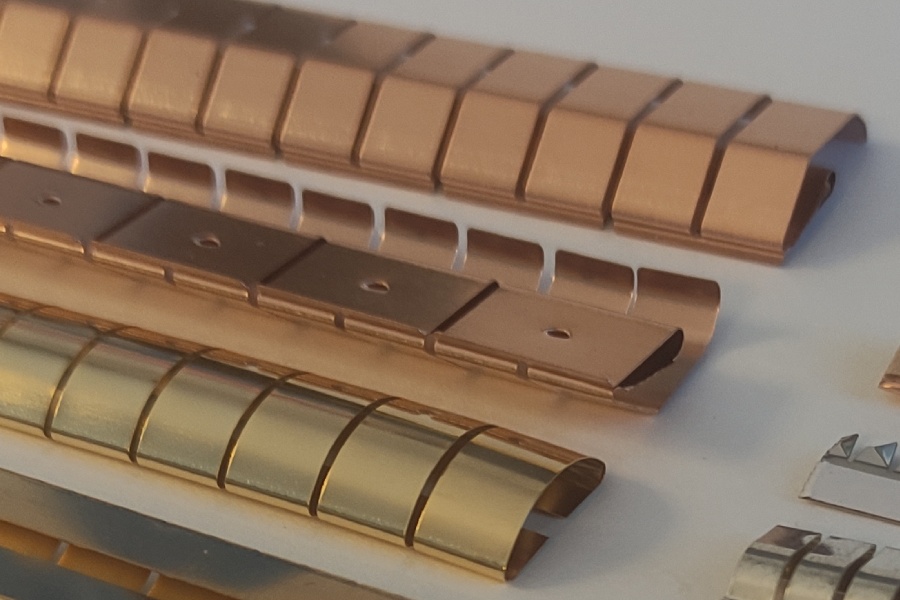
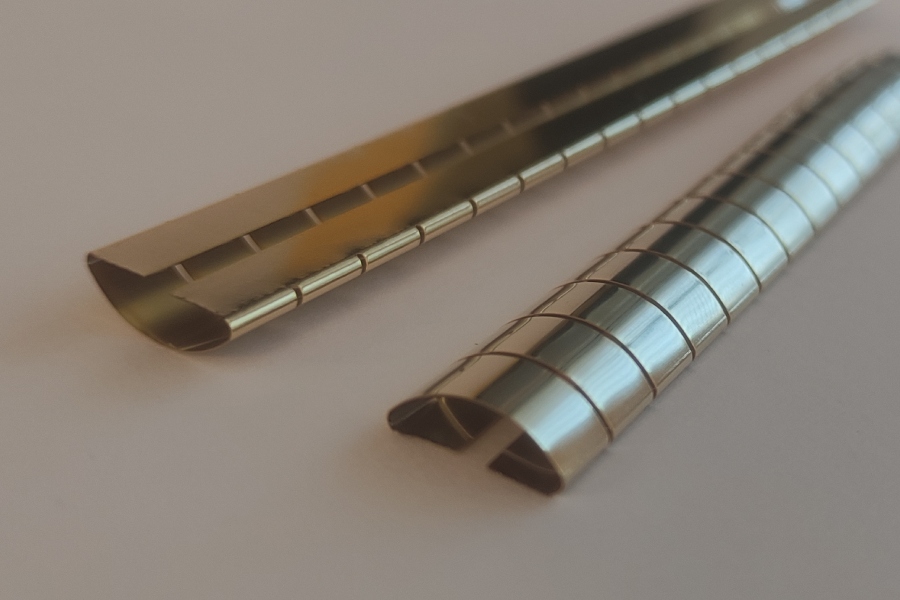
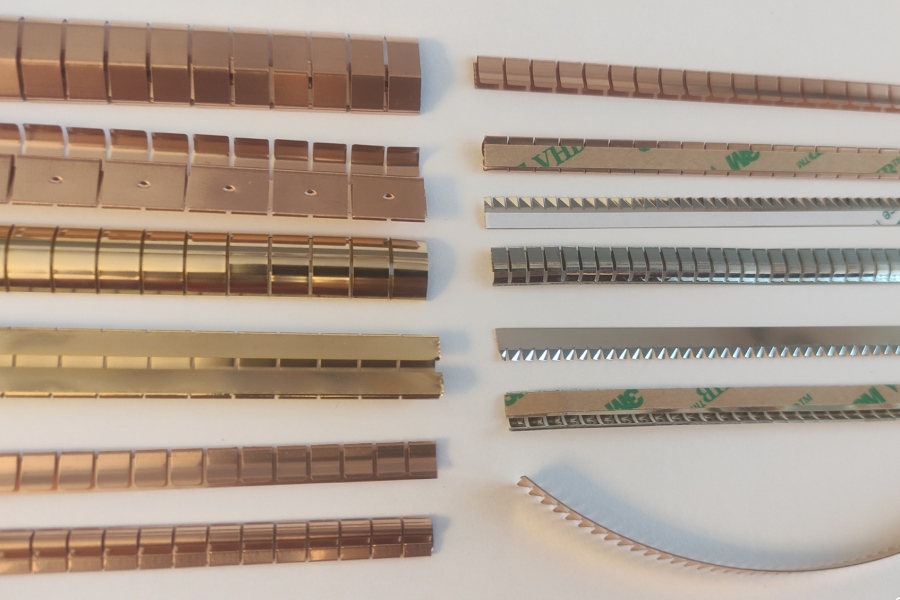
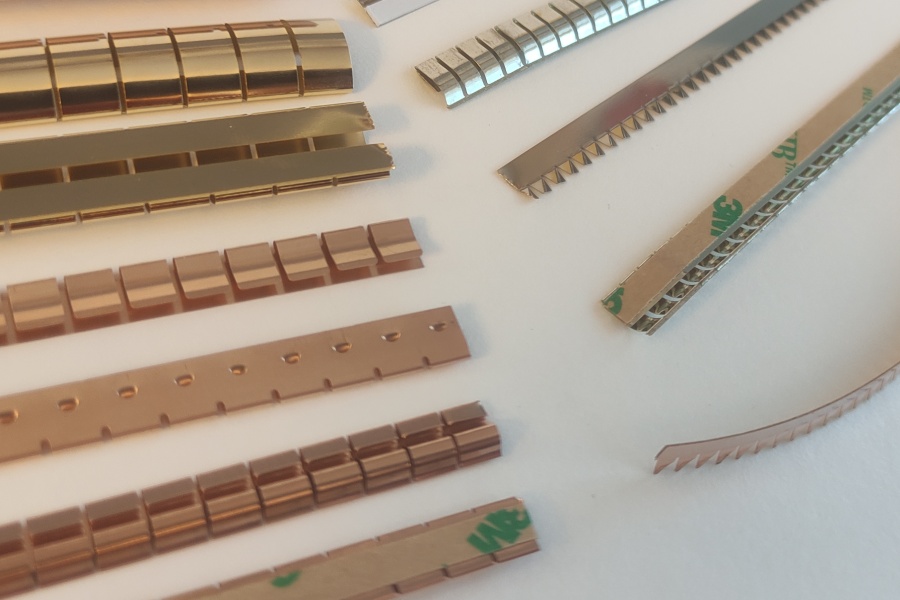
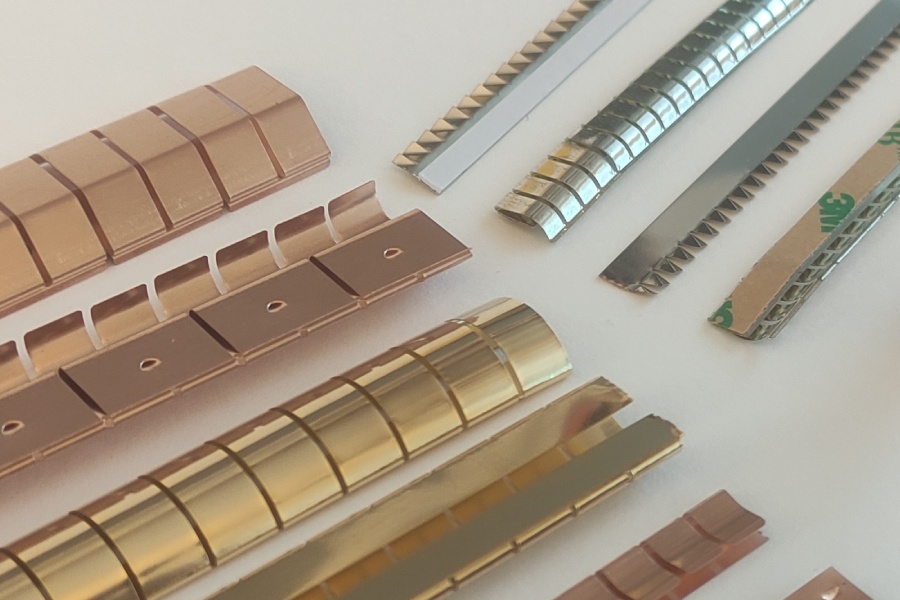
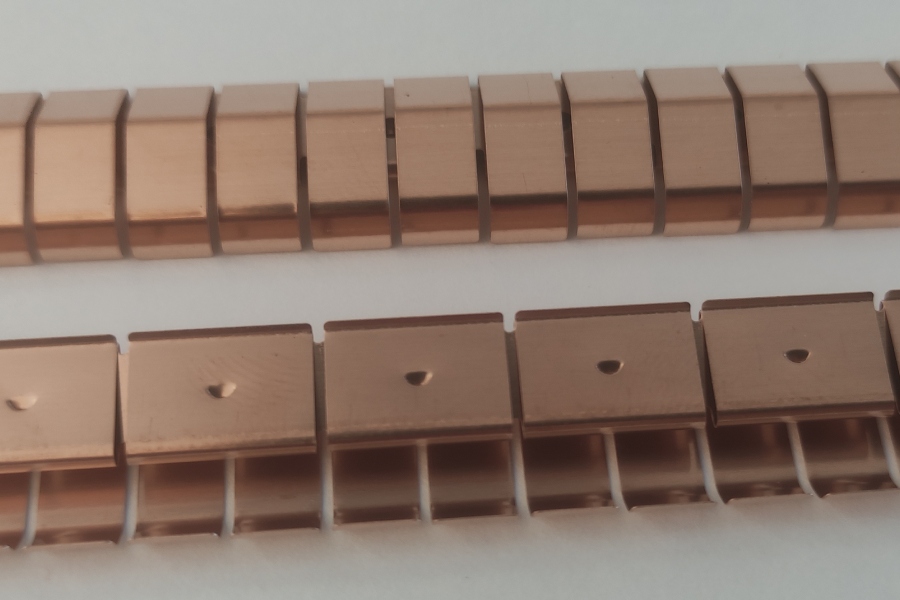
Finger stock is a thin strip of beryllium copper (BeCu) slit into a row of small spring fingers. Fitted along the edge of a door, a drawer or a removable panel, each finger presses against the facing metal and closes the gap that would otherwise let electromagnetic and radio-frequency interference (EMI/RFI) through. You will also see it called fingerstock, finger strip or contact fingers: it is the same product.
What sets it apart from other EMI gaskets is the spring. The strip is punched, formed, then heat-treated so that the metal remembers its shape: it needs very little force to close and comes back each time the door is opened. That makes it the usual choice for seams that are opened again and again.
✅ Advantages of beryllium copper finger stock
- High shielding effectiveness: up to 100 dB at 25 % compression, in magnetic field as in electric field (table below).
- Very low closing force: suited to light doors, plug-in modules and covers that cannot be clamped hard.
- Made for repeated opening: the fingers resist stress relaxation and keep their spring after many cycles, provided they are not over-compressed.
- Works in compression or in sliding contact: on a drawer or a sliding door the fingers wipe the facing metal and keep the contact surfaces clean.
- Plated to match your metalwork: tin, nickel, silver or gold, depending on the reference, to limit galvanic corrosion.
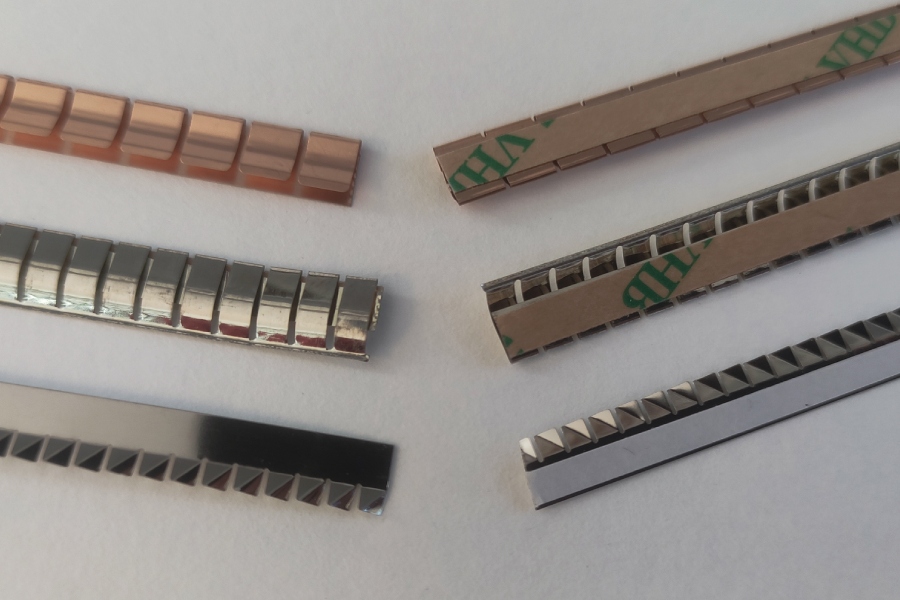
- Four ways of fixing: clip-on, conductive adhesive, soldering or riveting.
- All metal: resistant to moisture and UV, with no elastomer to age.
🔩 Choosing the mounting
- Clip-on: the strip clips over the edge of a flange, with no tool and no adhesive. It is the practical answer for retrofitting an existing enclosure, and the one to choose when the temperature rules out an adhesive.
- Adhesive-backed: a strip of pressure-sensitive adhesive holds the gasket on a flat face. Fast to fit and low in profile, for example on the front panels of rack-mounted cards. The surface must be clean and free of oil.
- Soldered or spot-welded: a permanent electrical and mechanical bond, for fixed installations.
- Riveted or screwed: profiles with mounting holes, for door frames and heavy-duty closures.
📦 Profiles, thicknesses and lengths
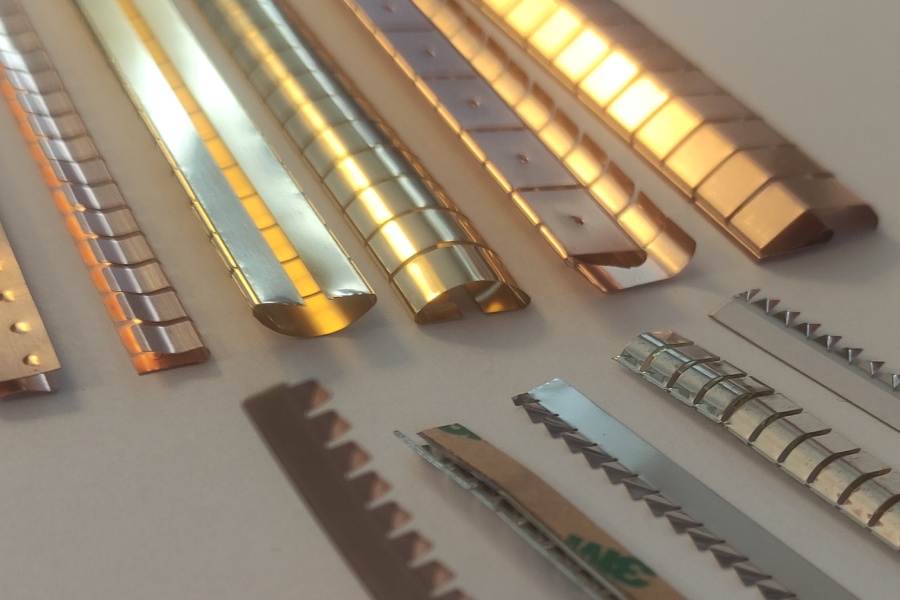
The range covers more than 50 standard profiles, from low strips for narrow gaps to tall fingers for doors that close unevenly. The beryllium copper strip is 0.05 to 0.18 mm thick: the thinner the strip, the softer the finger. Two grades follow from this: standard strips, which reach about 100 dB, and soft strips for the lowest closing forces, at 75 to 95 dB. Strips are supplied in lengths of 406 or 610 mm, some profiles in coils of 7.6 m, and can be cut to the length you need.
🧪 Material and plating
Beryllium copper is used because it combines two things that rarely go together: the conductivity of a copper alloy and the spring of a hardened steel. It keeps its elasticity under repeated flexing better than stainless steel or phosphor bronze, which is why it remains the reference for finger stock.
The bare alloy is bright and already resists corrosion well. A plating is chosen for the metal the fingers will touch, so that the two stay compatible and galvanic corrosion is limited. The usual finishes are tin, nickel, silver and gold. Tell us the metal and finish of the facing surface and we propose the plating. Stainless steel finger stock is available on request, for corrosive atmospheres or where beryllium copper is not accepted.
🔧 Technical data (typical values for the alloy)
- Alloy: copper with about 2 % beryllium (C17200, also known as alloy 25), heat-treated.
- Density: 8.36 g/cm³.
- Modulus of elasticity: about 131 GPa.
- Electrical conductivity: 22 % IACS or more after heat treatment.
- Thermal conductivity: about 100 W/m·K.
- Coefficient of thermal expansion: 17.5 × 10⁻⁶ per °C.
- Melting range: 870 to 980 °C.
These figures describe the alloy and are given as a guide. The values for a given strip are on its datasheet, sent with the quote.
🛠️ Finger stock made to your specification
The catalogue profiles are a starting point. Much of what we supply is adapted: a profile height matched to your gap, a softer or stiffer strip, a plating chosen for your flange, lengths cut to your dimensions, holes for your rivets, single fingers or short sections used as grounding contacts, or a part made entirely to your drawing. Send us the gap to close, the space available, the metals in contact and how the door moves; we come back with the matching reference and its datasheet with the quote, for a few prototype parts as for a series.
📏 Compression and fitting
The shielding figures are given at about 25 % compression: that is the working point to aim for. Leave the fingers room to move. Crushed flat, they lose their spring and the contact with it, so a stop or a rebate that limits the travel is good practice.
Finger stock shields; it does not seal. It keeps out neither water nor dust and is meant for indoor or protected equipment. Place it where it cannot be caught: exposed fingers on a doorway can snag on clothing or cables. With an adhesive-backed strip the tape sets the temperature limit, typically −55 °C to +121 °C; clip-on, soldered and riveted strips go higher, and the range is confirmed on the quote for the reference proposed.
📋 Typical applications
- Shielded rooms and Faraday cages: door frames and access panels, including MRI rooms and EMC test chambers.
- Cabinets and 19-inch racks: doors, drawers, plug-in modules and card front panels.
- Telecoms and network equipment: base stations, servers, switching bays.
- Medical, aerospace, defence and industrial electronics: enclosures opened regularly for maintenance.
- Grounding: single fingers or short strips as earth contacts between two parts.
Closing force and contact are best judged on your own door. You can order a sample of 3 pieces, prepared for your application, before committing to production.
❓ Frequently asked questions
What is finger stock?
An EMI gasket made of a thin metal strip formed into a row of spring fingers. Compressed between two metal parts, the fingers carry the current across the seam and close the gap to interference.
Why beryllium copper?
It conducts well and behaves like a spring. Once heat-treated, it returns to its shape after each compression, where softer copper alloys would stay bent.
Finger stock or knitted wire mesh gasket?
Finger stock for doors opened many times a day and for sliding contacts. Mesh for wider or more irregular gaps and rougher surfaces.
Clip-on or adhesive?
Clip-on if you have a flange edge to grip, or if the equipment runs hot. Adhesive on a flat face, when space is tight and the temperature stays within the limits of the tape.
Which plating should I choose?
Start from the metal the fingers will touch, so that the two sit close together in the galvanic series. We propose the plating once we know your flange material and its finish.
How much should the fingers be compressed?
About 25 % of their free height. The figure for the proposed profile is given with the quote.
Does finger stock seal against water or dust?
No. It is an EMI gasket only. If the same joint needs sealing, a separate seal is fitted alongside, or another type of gasket is used.
Can strips be cut to length?
Yes. Standard strips are 406 or 610 mm long and can be cut to your dimensions.
Can I test a sample first?
Yes: 3 pieces, prepared for your application.
Do you deliver small quantities?
Yes, from prototypes to series. The lead time depends on the reference and is confirmed on the quote.
| Type | Magnetic field | Electric field | Plane wave |
|---|---|---|---|
| Standard finger strip | ≈ 100 dB | ≈ 100 dB | ≈ 90 dB |
| Soft finger strip | ≈ 95 dB | ≈ 85 dB | ≈ 75 dB |
Other shielding and thermal products
Characteristics and values are given for guidance only. See our terms of sale for details. For any critical application, please contact us.