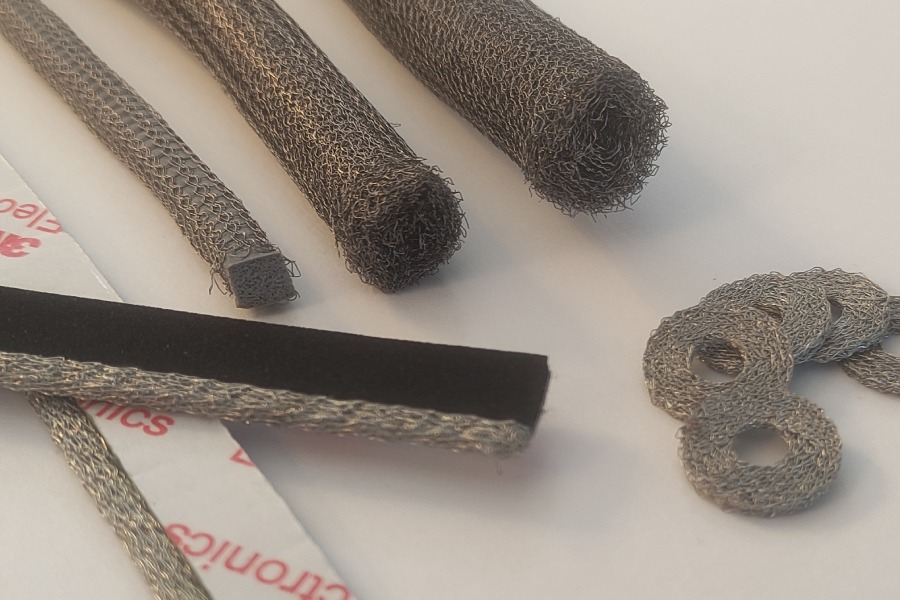
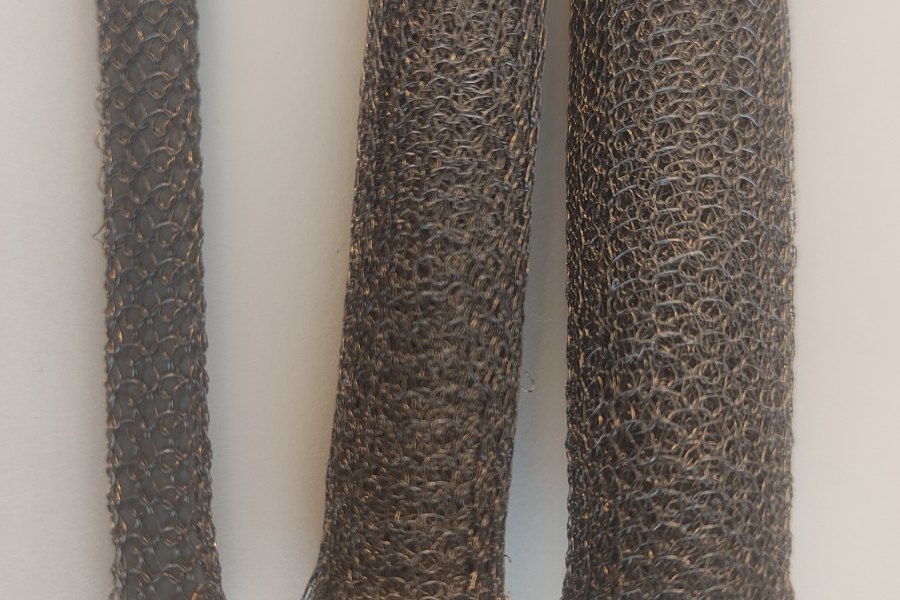
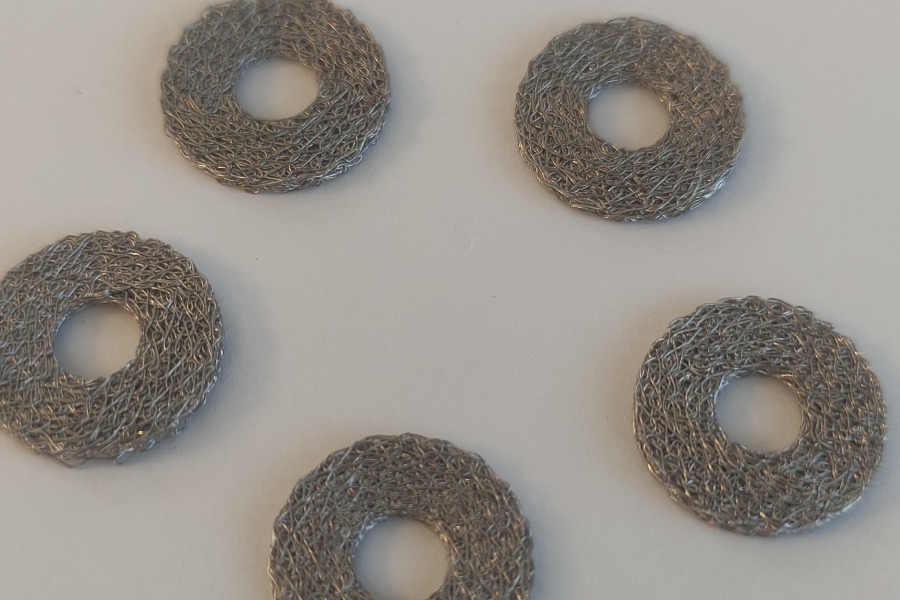
A knitted wire mesh gasket is made from a single fine wire knitted into interlocking loops, then rolled or pressed into a round, rectangular or flat section. Squeezed between two metal faces, the loops touch both of them at hundreds of points and restore the electrical contact that a door, a hatch or a removable panel interrupts. That contact is what stops electromagnetic and radio-frequency interference (EMI/RFI) from leaking through the seam.
The mesh comes in three constructions: all-metal, knitted over an elastomer core of silicone or neoprene, or bonded to a sealing strip when the same joint must also keep out dust and moisture. Which one you need depends mostly on how often the panel is opened and on what the gasket has to seal against.
✅ Advantages of knitted wire mesh gaskets
- High shielding effectiveness in magnetic field, electric field and plane wave: typically over 100 dB, and up to 130 dB depending on the alloy and the frequency (table below).
- Choice of wire: Monel, tin-plated copper-clad steel, phosphor bronze, silver-plated copper or stainless steel, so that the gasket can be matched to the metal of the flange and galvanic corrosion kept in check.
- Tolerant of uneven seams: with an elastomer core the mesh follows flanges that are not perfectly flat and recovers when the panel is opened.
- EMI shielding and sealing in one part: the combination version reaches up to IP65, depending on the assembly.
- Supplied the way you fit it: on reels, cut to length, as washers or as gaskets made to a drawing.
🔧 Three constructions
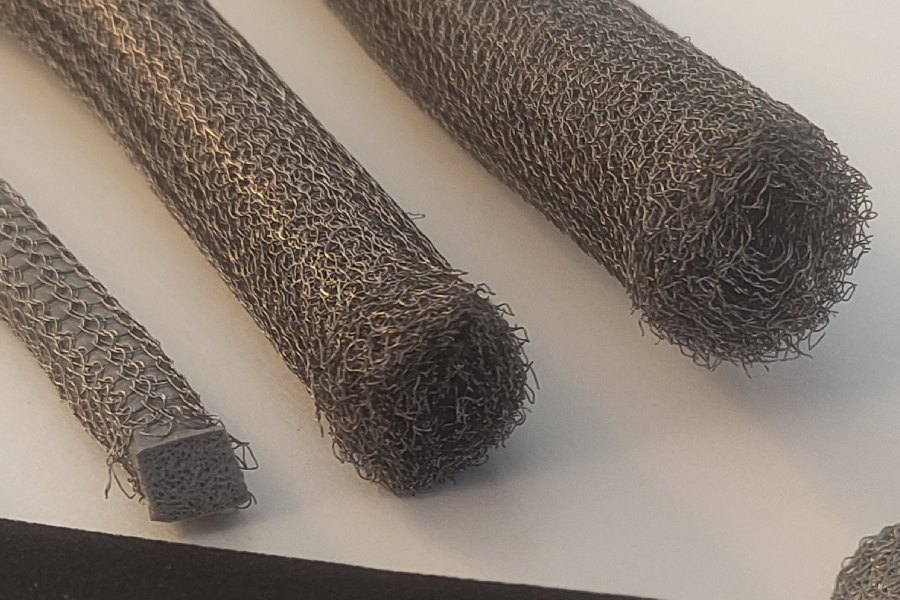
- All-metal mesh: round or rectangular sections from 1.6 to 12.7 mm. Nothing but wire, so it suits seams that are closed once and rarely opened: screened-room panels, bolted covers, fixed joints. It needs a firm closing force and takes a set once compressed.
- Mesh over an elastomer core: the same wire knitted around a silicone or neoprene sponge core, 1.6 to 12.7 mm. The core gives the spring: lower closing force, and the gasket recovers after each opening. This is the version for doors and hatches in regular use.
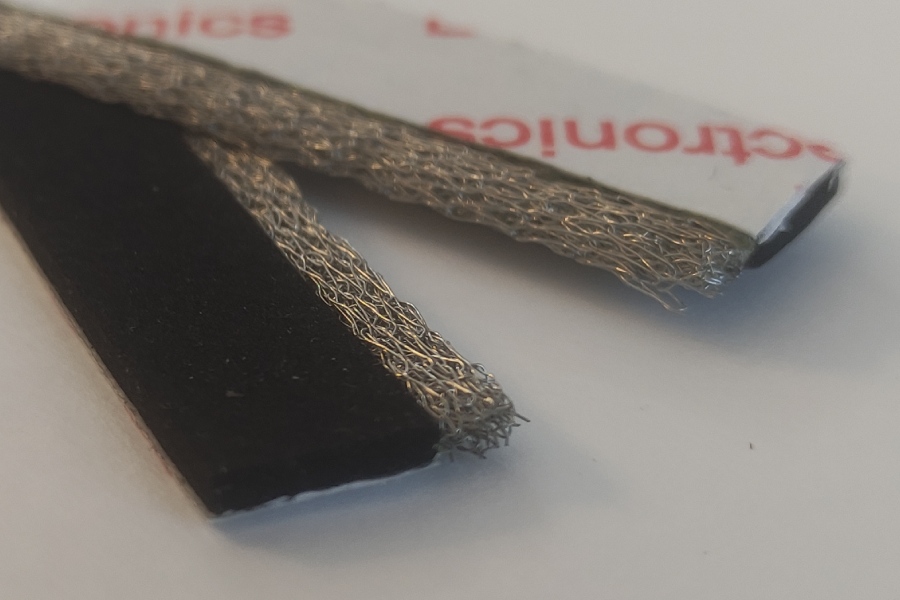
- Combination EMC gasket: a rectangular mesh strip bonded to a neoprene or silicone sponge seal. The mesh shields, the sponge seals against dust and moisture, up to IP65.
- Knitted mesh tape: flat tape 6.35 to 25.4 mm wide, used to wrap cables and harnesses or to bridge two parts.
- Mesh washers: in Monel or stainless steel, any size, made to your drawing.
🔩 Choosing the wire
- Monel (nickel-copper alloy): the general-purpose choice, with good corrosion resistance, including in marine atmospheres.
- Tin-plated copper-clad steel (Sn/Cu/Fe): a steel core, about 57 % of the wire, under 40 % copper and a thin tin plating. The steel helps against low-frequency magnetic fields: around 80 dB at 100 kHz, against 60 dB for Monel.
- Tin-plated phosphor bronze: springy, and the highest plane-wave figures of the range (about 110 dB at 1 GHz).
- Silver-plated copper: the most conductive surface, for low contact resistance.
- Stainless steel: hard-wearing and resistant to oxidation; used mainly for washers.
- Aluminium: on request, where weight matters and the flange is aluminium too.
The first question is always what the gasket will touch. Tell us the metal and the finish of your flanges and we propose the wire that sits closest to them in the galvanic series.
🛡️ Silicone or neoprene core
A silicone sponge core covers the widest temperature range, −50 °C to +200 °C, and keeps its elasticity for years. Neoprene stands up well to oils, fuels and weathering, which makes it a common choice for industrial cabinets. Other temperature ranges depend on the core and the alloy; they are confirmed on the quote, with the datasheet of the reference.
🛠️ Gaskets made to your specification
The sizes in the table are the usual ones, not a limit. Most of what we supply is made to order: a section that fits your groove, a wire matched to your flange, a core chosen for your temperature, lengths cut to your dimensions, washers and special shapes to a drawing, an adhesive strip under the sealing part of a combination gasket. Send us the dimensions or the plan, the metals in contact and what the gasket has to withstand; we come back with the matching reference and its datasheet attached to the quote, for a few prototype parts as for a series.
📏 Compression and fitting
With a sponge core, plan for the gasket to be compressed by about 20 to 30 % of its height: enough for the wire to bite through the oxide film on the flange, not so much that the core is crushed. All-metal mesh needs more force and a rigid flange, with fixings close enough together to keep the pressure even along the seam. If the cover is too light for that, a fabric-over-foam gasket closes with far less force.
Both faces must be clean, degreased and conductive: paint or anodising under the gasket breaks the contact. A cut mesh end can shed loose wires; they are stopped with a drop of adhesive, a spot weld or a few stitches. If you want the ends finished before delivery, say so in your enquiry.
📋 Typical applications
- Doors, hatches and covers of enclosures, cabinets and 19-inch racks.
- Shielded rooms: panel joints and access doors.
- Cable and harness shielding with knitted mesh tape.
- Outdoor and industrial cabinets: combination gaskets where dust and moisture must be kept out as well.
- Aerospace, defence, telecoms, medical, automotive and industrial equipment.
The surest way to check closing force and contact on your own enclosure is to try the gasket. You can order a sample of 3 pieces, cut for your application, before committing to production.
❓ Frequently asked questions
What is a knitted wire mesh gasket?
An EMI gasket made of fine metal wire knitted into loops and formed into a strip, with or without an elastomer core. Compressed between two metal parts, it carries the current across the seam.
What is the difference between woven and knitted mesh?
Woven mesh is made of wires crossing at right angles, like a cloth: it is flat and stiff. Knitted mesh is made of loops of one continuous wire: it compresses and springs back, which is what a gasket needs.
Can a mesh gasket seal against water?
Not on its own: bare mesh, even over a core, only limits dust. For dust and moisture, choose the combination version, mesh bonded to a sponge seal, up to IP65 depending on the assembly.
All-metal or elastomer core?
All-metal for joints that stay closed; a core for anything opened regularly, because all-metal mesh does not recover its height once compressed.
Which wire should I choose?
Start from the flange metal to limit galvanic corrosion, then from the frequencies to be shielded: Monel for general use, tin-plated copper-clad steel when low-frequency magnetic fields are involved.
How much should the gasket be compressed?
About 20 to 30 % of its height with a sponge core. The exact value for the proposed reference is given with the quote.
Is there an adhesive version?
Yes, on combination gaskets: the adhesive strip sits under the sponge seal, and the mesh stays bare so that it touches the metal.
Mesh gasket or finger stock?
Mesh accepts wider gaps and rougher surfaces; finger stock suits sliding contacts and doors opened many times a day.
Can you supply a size that is not in the table?
Yes. Give us the section and the length, or a drawing, and we propose the matching reference.
Can I test a sample first?
Yes: 3 pieces, cut for your application.
Do you deliver small quantities?
Yes, from prototypes to series. The lead time depends on the reference and is confirmed on the quote.
| Type | Mesh material | Shape | Core / seal | Usual sizes |
|---|---|---|---|---|
| All-metal | Monel, tin-plated copper-clad steel, phosphor bronze, silver-plated copper | Round, rectangular / flat | — | Ø 1.6 to 12.7 mm |
| Mesh over sponge core | Monel, tin-plated copper-clad steel, phosphor bronze, silver-plated copper | Round, rectangular | Neoprene or silicone sponge | Ø 1.6 to 12.7 mm |
| Combination EMC gasket | Monel, tin-plated copper-clad steel, phosphor bronze, silver-plated copper | Rectangular | Neoprene or silicone sponge | Seal: (1.6–6.35) × (6.35–15.88) mm Mesh: (1.6–6.35) × (3.18–6.35) mm |
| Washers | Monel, stainless steel | Round | — | Any size, to drawing |
| Knitted mesh tape | Monel, tin-plated copper-clad steel, phosphor bronze, silver-plated copper | Flat | — | Width 6.35 to 25.4 mm |
| Material | Magnetic field 100 kHz | Electric field 10 kHz | Plane wave 1 GHz | Plane wave 10 GHz |
|---|---|---|---|---|
| Tin-plated copper-clad steel | ~80 dB | ~130 dB | ~105 dB | ~95 dB |
| Tin-plated phosphor bronze | ~80 dB | ~130 dB | ~110 dB | ~100 dB |
| Aluminium | ~60 dB | ~130 dB | ~90 dB | ~80 dB |
| Monel | ~60 dB | ~130 dB | ~90 dB | ~80 dB |
Other shielding and thermal products
Characteristics and values are given for guidance only. See our terms of sale for details. For any critical application, please contact us.