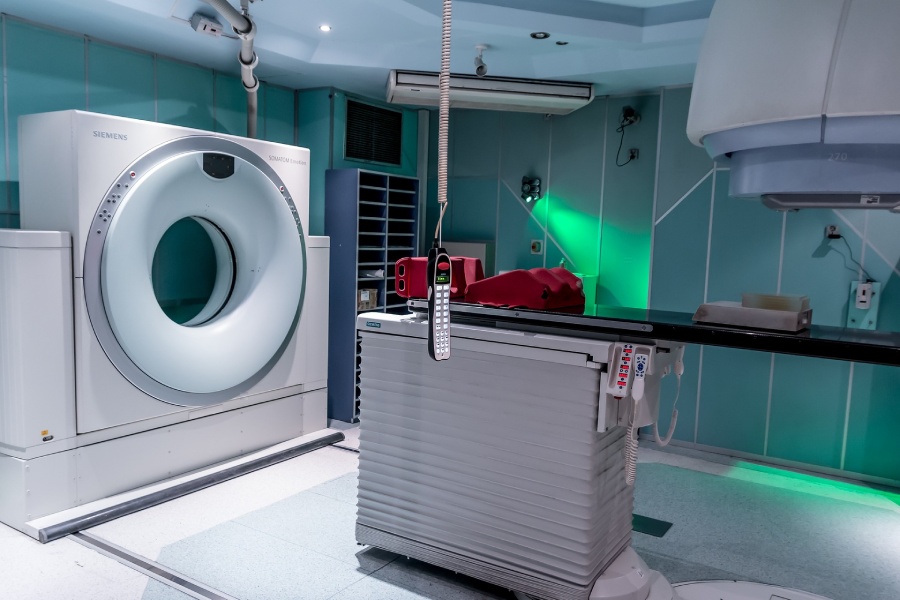
A hospital is a crowded place for radio waves: mobile phones, Wi-Fi, RFID readers, electrosurgical units and imaging systems all work within a few metres of monitors, pumps and analysers. A medical device has to keep doing its job in the middle of that, and must not disturb the equipment beside it. That is the electromagnetic compatibility (EMC) of the device, and it is assessed as part of its safety.
Much of it is decided at the enclosure. ElectroDome supplies the gaskets that keep a housing electrically closed at its seams, doors and connectors, and the thermal pads that take the heat out of compact, sealed electronics.
🩺 Where these materials are used
- Imaging systems (MRI, CT, X-ray): electronics cabinets, and the doors and panels of shielded rooms.
- Patient monitoring and diagnostic equipment: small housings with displays, connectors and removable covers.
- Laboratory analysers: sensitive measurement boards next to motors and power supplies.
- Connected and portable devices: a radio module and its own electronics sharing one small case.
- Power supplies and control units: heat to remove from boxes that are closed for hygiene.
🔧 Five families, five uses
Heat first: silicone thermal pads
Medical housings are often sealed so that they can be wiped clean, which leaves conduction as the only way out for the heat. Thermal interface pads in silicone, at 3 or 5 W/m·K, fill the gap between a component and the case or heat sink. They are electrically insulating and rated UL 94 V-0.
Doors opened all day: finger stock
The door of an MRI room is opened dozens of times a day and must restore the room's RF shield each time it closes. That is the classic use of beryllium copper finger stock gaskets: a row of spring fingers around the door frame, closing with little force and reaching up to 100 dB at 25 % compression. The same strips serve on cabinet doors and drawers of imaging electronics.
Shielding and sealing together: conductive silicone
Where a housing must be closed to liquids as well as to interference, conductive silicone gaskets do both in one part: 40 to 110 dB depending on the filler, and sealing against water and dust when the gasket is properly compressed. Supplied as cut gaskets, O-rings or extruded profiles.
Light covers: fabric-over-foam
Plastic or thin metal covers cannot take a hard gasket. Fabric-over-foam EMI gaskets compress with very little force, are rated UL94-V0 and come with an adhesive strip for quick fitting inside monitors, analysers and bedside equipment.
Cabinets and racks: knitted wire mesh
For the metal cabinets that house the electronics of an imaging system, wire mesh EMI gaskets give over 100 dB depending on the alloy and the frequency and tolerate flanges that are not perfectly flat. A version bonded to a sponge seal also keeps out dust.
📐 IEC 60601-1-2 in two paragraphs
IEC 60601-1-2 is the collateral standard to IEC 60601-1 that deals with electromagnetic disturbances: what a medical electrical equipment may emit, and what it must withstand without losing its basic safety or its essential performance. Its immunity levels depend on where the device is used: a professional healthcare facility, home healthcare, or a special environment.
The standard is applied to the finished device. Shielding the enclosure is one of the means a designer has to meet it, and a well-chosen gasket contributes to the result. We give you the data of the material (shielding effectiveness, temperature range, flammability rating) so that you can select it and validate it in your own tests.
🛠️ Cut and formed for your device
Medical equipment is built in modest series, and almost never around a catalogue gasket. Send us the drawing of the seam or the cover, the housing material, the cleaning agents the device will meet and the closing force you have; we propose the matching reference, cut to shape, with its datasheet attached to the quote. A sample of 3 pieces lets you check the fit before the series.
🤝 What you can expect from us
- EMI shielding and thermal materials from one supplier, based in Paris, replying in English or French.
- Traceable materials: each batch is identified, and checked before it leaves for you.
- Prototype quantities and small series handled like any other order.
- Indicative data, stated as such, and confirmed on the quote for the reference proposed.
❓ Frequently asked questions
What is IEC 60601-1-2?
The part of the IEC 60601 series that covers electromagnetic disturbances for medical electrical equipment: emission limits and immunity tests, set according to the environment in which the device is used.
Can your gaskets be used in a device tested to IEC 60601-1-2?
Yes: they can contribute to its compliance. The standard qualifies the finished device, so the result is confirmed by your own tests, and we provide the material data you need.
Which gasket for the door of an MRI room?
Beryllium copper finger stock, fitted around the frame: it is made for doors that are opened and closed many times a day.
Which gasket for a plastic housing?
A fabric-over-foam gasket on a conductive-coated or metallised surface: it needs very little closing force.
Can I order a sample or a small quantity?
Yes: a sample of 3 pieces, then prototypes or series. Availability and lead time depend on the reference and are confirmed on the quote.
Characteristics and values are given for guidance only. See our terms of sale for details. For any critical application, please contact us.