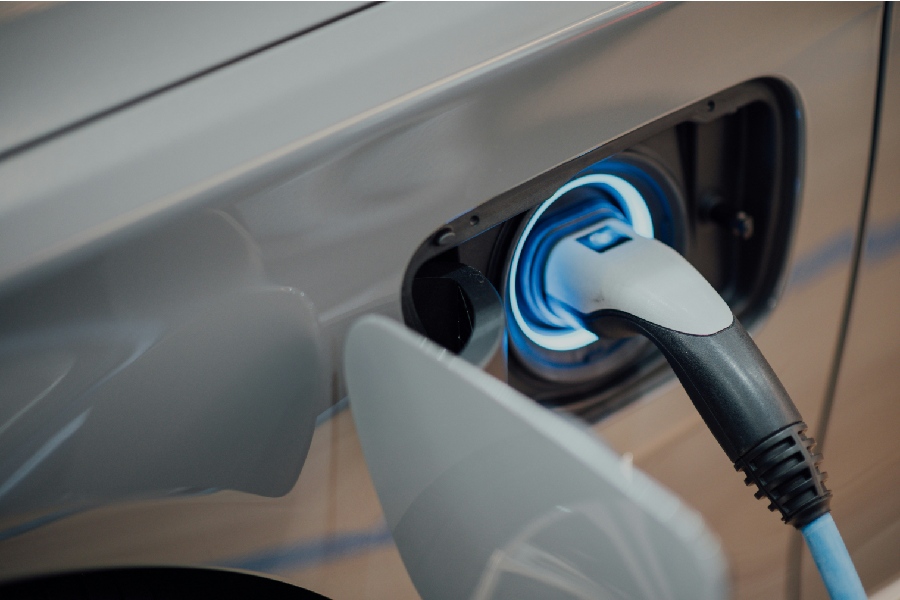
A modern car is a radio environment in miniature. Traction inverters, DC-DC converters and on-board chargers switch hundreds of volts at high frequency; in the same tightly packed vehicle, radar and camera modules, satellite-navigation receivers and the radio itself work with very small signals. Electromagnetic compatibility (EMC) is what lets the two groups share one body shell.
Shielding is designed at three levels: the enclosure, the module inside it and the circuit board. ElectroDome supplies the EMI gaskets that close the joints of an enclosure, and the thermal pads that carry the heat of its electronics to the casing. This page goes through the vehicle zone by zone.
🚗 Vehicle electronics concerned
- Power electronics of electric and hybrid vehicles: traction inverter, DC-DC converter, on-board charger.
- Battery packs and their management electronics: large covers, long sealing lines.
- Electronic control units (ECUs): engine, body and battery-management controllers.
- ADAS sensors: radar, camera and ultrasonic modules, which work with very small signal levels.
- Infotainment and telematics units: cellular, Wi-Fi, Bluetooth and satellite navigation in one box.
- Charging stations: outdoor cabinets that need shielding and weather protection together.
🔧 Through the vehicle, zone by zone
High-voltage housings: inverter, charger, battery
These housings have to keep the weather out as well as the interference in, along covers that can be very long. A conductive silicone profile or O-ring, extruded and laid in the groove of the housing, does both: 40 to 110 dB depending on the filler, service from −55 °C up to +125 °C or +200 °C, and, with the right groove and compression, sealing to IP65, IP66 or IP67. A fluorosilicone version adds chemical resistance.
Power modules: getting the heat out
An inverter or a charger turns part of its power into heat, inside a housing that is closed. Thermally conductive pads in silicone fill the gap between a power module or a board and the wall or heat sink that cools it, at 3 or 5 W/m·K. They are electrically insulating, rated UL 94 V-0, work from −40 °C to +220 °C and start at 0.3 mm thick.
Control units in metal housings
Where a control unit has a metal housing with a cover screwed down once, on flanges that are not perfectly flat, EMI mesh gaskets in knitted wire follow the irregularities and give over 100 dB depending on the alloy and the frequency. The wire is chosen to match the metal of the housing. Bonded to a sponge seal, the same gasket adds environmental sealing up to IP65.
Plastic housings and cabin electronics
To save weight, many modules have moulded plastic housings, which shield only once they carry a conductive coating. Where such a housing, or the thin cover of a head unit or a display, leaves little closing force, conductive fabric-over-foam gaskets are the usual choice: they compress with very little force, are rated UL94-V0 and are fitted with their adhesive backing. They belong in the cabin and other dry, protected places: −10 °C to +110 °C, down to −40 °C depending on the reference.
Charging cabinets and service doors
A maintenance door, on the cabinet of a charging station for instance, must make contact again along its full length each time it closes. EMI finger stock in beryllium copper does that with little force and reaches up to 100 dB at 25 % compression. It does not seal, so on an outdoor cabinet it sits behind the weather seal. Short lengths also serve as grounding contacts between a shield and its housing.
📐 CISPR 25, ISO 11452 and UN Regulation No. 10
Three references recur in automotive EMC work. CISPR 25 sets limits and measurement methods for radio disturbances from 150 kHz to 5 925 MHz, for vehicles and for the components fitted in them; its purpose is to protect the receivers on board, from broadcast radio to satellite navigation, Wi-Fi, Bluetooth and V2X. ISO 11452 deals with immunity: a series of component test methods in which the device and its wiring harness are exposed to narrowband radiated electromagnetic energy. UN Regulation No. 10 is the type-approval text: it covers the EMC of vehicles and of the components intended for them, in emissions and in immunity, with additional requirements for vehicles that connect to the grid to charge.
CISPR 25 states that its limits are recommended and may be modified by agreement between the vehicle manufacturer and the supplier. Whatever the target agreed, it is measured on the finished module, with its harness. A gasket matched to the housing contributes to the compliance of that module. With the quote we send the material data (shielding effectiveness, temperature range, filler or alloy, flammability rating) so that you can make your choice and confirm it in your own tests.
🛠️ From your housing drawing to the part
Automotive housings are designed around their own grooves and covers, not around a catalogue gasket. Send us the section of the groove or the flange, the housing material and its finish, the temperature range at that location, the fluids the joint may meet and the IP rating you are aiming for. We reply with the reference that matches, as extruded profile, cut gasket or pad, and its datasheet comes with the quote. We supply prototype quantities and small series as well as production runs.
🤝 ElectroDome as your supplier
- EMI gaskets and thermal pads from the same supplier, based in Paris, with replies in English or French.
- Three sample pieces to fit on your housing before any series.
- Every batch traceable, and checked before dispatch.
- Material figures given as indicative values and confirmed on the quote for the reference proposed.
❓ Frequently asked questions
What is EMC in automotive?
The ability of each electronic unit of a vehicle to work next to the others without disturbing them or being disturbed. In practice: emission limits and immunity tests, applied to components and to the whole vehicle.
What is CISPR 25?
The international standard that limits the radio disturbances produced by vehicles and their components, so that on-board receivers keep working. It covers 150 kHz to 5 925 MHz.
Can your gaskets be used in a module tested to CISPR 25 or ISO 11452?
Yes: they can contribute to its compliance. These standards apply to the finished module, so the result is confirmed by your own tests, with the material data we provide.
Which EMI gasket for a battery or inverter housing?
Where the housing must also be watertight, a conductive silicone profile or O-ring in a groove. The filler is chosen with the housing metal in mind, to limit galvanic corrosion.
Does an EMI gasket work on a plastic housing?
Only if the plastic carries a conductive coating or metallisation: the gasket needs a conductive surface on both sides.
Can I get samples before a series?
Yes: 3 pieces of the reference proposed. Availability and lead time depend on the reference and are stated on the quote.
Characteristics and values are given for guidance only. See our terms of sale for details. For any critical application, please contact us.